
Tag Archive for Intel

Intel to Invest In America

Intel to Invest In AmericaThis week, Intel (NASDAQ: INTC) announced it will invest In America. Chipzilla will invest between $6 billion and $8 billion in American-based manufacturing facilities. Dailywireless says this investment in America will fund the deployment of Intel’s next-generation 22 nanometers (nm) manufacturing process across several existing U.S. factories and building a new development fabrication plant in Oregon. The Oregon factory should be ready in 2013 and will primarily produce chips for research and development as Intel advances its designs.

In an era when politicians and Wall Street refuse to invest in America, Intel has shown its leadership. “This is probably the largest private investment during this last two or three years in this country,proclaimed Oregon Governor Ted Kulongoski. The projects will support 6,000 to 8,000 construction jobs and result in 800 to 1,000 new permanent high-tech jobs according to media reports.

Highlights

  • Intel will invest in America with $6-8 billion in manufacturing to support future technology advancements in Arizona and Oregon.
  • The investment will create 6,000-8,000 construction jobs and 800-1,000 permanent high-tech jobs, and allows Intel to maintain its current manufacturing employment base in the U.S.
  • The investment will fund a new development fab in Oregon, as well as upgrades to four existing U.S. fabs (Fab 12 and Fab 32 in Arizona and D1C and D1D in Oregon) to manufacture the next-generation 22-nm process technology.
  • Intel’s next-generation, 22 nm microprocessors will enable sleeker device designs, higher performance, and longer battery life at lower costs.

Intel’s upcoming 32-nanometer “Sandy Bridge” Core architecture got much of the attention at the company’s developer show last month. Sandy Bridge chips, built using 32 nm architecture, will be out early in 2011. Ivy Bridge is the codename given to the 22 nm die shrink of Sandy Bridge.

The “tick” (new architecture) of 32 nm Sandy Bridge, available in January 2011, will be followed by the “tock” (22 nm shrink) of Ivy Bridge in January 2012. The new D1X plant may be built with the 15 nm process in mind since that process would likely be mainstreamed just 12 months after D1X begins production.

Moving to 22-nanometer could also help the company produce chips with lower power consumption to better compete in smartphones—where designs from ARM currently dominate. Intel launched the Atom platform two years ago. Now executives are looking to aggressively expand the reach of the Atom chips, into tablets, handheld devices, and phones.

Intel Technology Outlook

Intel is also building its first production facility in China, reports Bloomberg. Intel is vying with Samsung Electronics to be the industry’s biggest spender on plants and equipment in 2010. Intel’s microprocessors run more than 80 percent of the world’s personal computers. Rival Samsung is the biggest maker of memory chips.


Ralph Bach has been in IT long enough to know better and has blogged from his Bach Seat about IT, careers, and anything else that catches his attention since 2005. You can follow him on LinkedInFacebook, and Twitter. Email the Bach Seat here.

Hourglass Syndrome

Hourglass SyndromeA July 2010 technology online study conducted by Harris Interactive (NASDAQ: HPOL) and sponsored by Intel Corporation (NASDAQ: INTC), reveals that eight out of 10 (80%) U.S. adults get frustrated waiting for technology, and over half (51%) have done something out of character when frustrated while waiting for technology. Intel calls this the “Hourglass Syndrome.

Intel logoIntel says that of those who suffer from the hourglass syndrome:

  • 69% admitted acting inappropriately while waiting.
  • 62% of U.S. adults admit to yelling or cursing out loud when their technology can’t keep up with them.
  • 29% hit their computer mouse.
  • 24%  bang on their computer screen and keyboard, hopefully not to the extent as the guy in the video.

The integral role technology plays in everyday life causes the hourglass syndrome phenomenon says the chipmaker. Intel marketing experts say the “malady” has developed with the modern pace of life. In an environment where mobile devices are constantly on to answer emails within minutes of receiving them, people feel anger and frustration when outdated technology fails to keep up with the speed of life.

Margaret (Margie) Morris, a clinical psychologist and health technology researcher at Intel, states in the Intel press release;”We are closely connected with our devices  … They become extensions of ourselves and become critically involved in our relationships with others, how we express ourselves, and our efforts to manage stress. We enjoy the freedom to communicate and work from anywhere, so we rely on the technology to work. When it lets us down, the disappointment runs high and sometimes spills over into our feelings about ourselves.

Of those who have acted or seen someone act inappropriately in public due to frustrations with technology:

  • 70% saw strangers.
  • 46% have seen family or friends.
  • 33% have seen co-workers act out in frustration while waiting for technology.

According to the online survey taken between July 27-29, 2010 sluggish technology often causes people to miss out on something while they are waiting. 35% of U.S. adults said that they missed out on something while waiting for technology, such as losing an opportunity to take part in an online sale (13%) or buy airline, concert, or sporting event tickets. “Intel understands how stressful technology can be,” said Karen Regis, Director of Intel’s Consumer PC Marketing in the press release. “We are determined to design products that can improve the quality of your life and lower your stress levels, as opposed to increasing them.

rb-

Kudos to Intel for the imaginative use of pseudo-science to wrap a marketing message for Intel Turbo Boost Technology in a factoid.  GigaOm points out that Intel, “helpfully notes that Hourglass Syndrome “is not a real syndrome or medical condition.”


Ralph Bach has been in IT long enough to know better and has blogged from his Bach Seat about IT, careers, and anything else that catches his attention since 2005. You can follow him on LinkedInFacebook, and Twitter. Email the Bach Seat here.

Intel Shows TBps Connections

Intel Shows TBps ConnectionsThe EETimes reports that researchers at Intel Corp. (INTC) have demonstrated optical chips can transmit up to terabit-per-second of data transmission. The new silicon photonic chips will replace copper connections in everything from supercomputers to servers to PCs chips predicts Intel. The new chips can currently transmit data at 50 Gigabits per second (Gbps). 50 Gbps equates to transferring an HD movie a second.

This milestone marks the beginning of silicon photonics in the high-volume marketplace, in applications from [high-performance computing] all the way down to the client PC,” said Mario Paniccia, director of Intel’s Photonics Technology Lab. “We see a clear development path from 50 Gbps today to a terabit in the future,” Mr. Paniccia told EETimes.

Intel says that optical connections could eventually replace the copper connections between systems and even between boards in the same system and down to cores on the same board. intel’s Paniccia estimated that the first commercial applications of silicon photonics will begin appearing in as little as five years in data centers and supercomputer facilities.

The modulators required to encode optical information using signal waveguides and photodiodes are cast in silicon on custom chips designed by Intel. The transmitter chip uses Intel’s hybrid silicon laser technology that bonds a small indium phosphide die to on-chip silicon waveguides, four of which are patterned into a connected optical laser.  “We combined our silicon manufacturing techniques with our hybrid laser and demonstrated an integrated transmitter using four lasers each operating at a different wavelengths and four silicon modulators each operating at 12.5 Gbps, then combined them together into an aggregate 50 Gbps into the optical fiber,” said Paniccia.

The optical fiber output on the receiver chip is then filtered into separate colors and diverted by waveguides into four separate photodiodes, each of which receives one of the four separate 12.5-Gbps channels. In the future, Intel plans to add more lasers per chip and increase the number of channels. Intel believes that it can put 25 lasers on a single chip to produce the 1 Tbps capabilities. It then hopes to commercialize the optical connection technology.  Intel has been developing the technology since 2004.

Intel already has a 10-Gbps Light Peak chip that uses conventional optical technologies that are aimed at reducing the number of port connections on a computer. The Silicon Photonics Link is different from Light Peak technology. Intel’s Light Peak technology – an optical cable that is aimed at reducing the number of port connections on a computer. said it used traditional optical devices and scaling it beyond 10 Gbps speeds would be difficult.

rb-

For some perspective, the 1 terabit per second link could transfer the entire printed collection of the Library of Congress in 1.5 minutes.

Intel is preaching high bandwidth and low cost with these chips. If Intel can deliver, it could change the nature of system design. Theoretically, these chips could allow system components to the spaced further apart without the performance hit. With these chips, data center expansion could be down the hall instead of a full re-design. Now it may be cheaper to take the new gear to the available electrical panel rather than adding a new panel to the server room.

Intel’s Paniccia told VentureBeat that the accuracy of the data transfer is superb. So far, it has been proven to be able to transfer data with no errors for 27 hours straight, which means it can transfer more than a petabyte of data without an error.


Ralph Bach has been in IT long enough to know better and has blogged from his Bach Seat about IT, careers, and anything else that catches his attention since 2005. You can follow him on LinkedInFacebook, and Twitter. Email the Bach Seat here.

Wireless Gigabit

WiGig AllianceThe Wireless Gigabit Alliance has completed specs for a technology designed to deliver as much as 7 Gbps of wireless bandwidth in the 60 GHz band. The new technology, WiGig has the support of technology giants such as Intel, Broadcom, and Atheros. The technology is expected to have enough capacity to deliver high-def video streams up to 10 meters. WiGig’s anticipated road map includes system certifications in 2010 and WiGig based products to market in 2011.

Supplement other wireless technologies

According to the WGA, WiGig is not designed to replace 802.11 or Bluetooth but rather to supplement it. WiGig is a device-to-device (p2p) network and does not need a central hub or router that could easily turn into a congestion point. WiGig uses beamforming to extend its range beyond the 10-meter range and will automatically switch to 802.11n Wi-Fi.  “Our technology is backward compatible with existing Wi-Fi, and we fall back to 802.11n and 802.11g when we can’t connect at [7 Gbps] speeds,” Ali Sadri, told TechNewsWorld. “We’re based on 802.11, so our spec is not replacing Wi-Fi but extending it to 10 to 20 times faster than Wi-Fi.

By complementing Wi-Fi and enabling multi-gigabit speeds, the versatile specification is a very significant achievement on the road to the next generation of wireless LAN products,says Craig Mathias, a Principal with the wireless and mobile advisory firm Farpoint Group.

Integrate WiGig into Wi-Fi chipsets

It is reported that Intel, Broadcom, and Atheros all have plans to integrate WiGig into Wi-Fi chipsets. “Ultimately, the question is how many different kinds of radios do you really need?says Farpoint’s Mathias, “There’s not just competition from Wi-Fi and wireless HD but also cellular technologies such as 3G, LTE or WiMax … A lot of people anticipate 60 GHz products that will include 2.4 and 5 GHz Wi-Fi as well,” said Bill McFarland, chief technology officer of Atheros, and a WiGig member. “I definitely think we can support tri-band at 65 nm,” he added.

WiGig will include protocol adaptation layers to support specific system interfaces including data buses for PC peripherals and display interfaces for HDTVs, monitors, and projectors. WiGig will include advanced security and power management for WiGig devices. “We’re rapidly paving the way for the introduction of the next generation of high-performance wireless products – PCs, mobile handsets, TVs and displays, Blu-ray disc players, digital cameras, and many more,said Doctor Ali Sadri of Intel and president and chairman of the Wireless Gigabit Alliance

The need for fast wireless data transfer plays into two big trends: the proliferation of multimedia and the increasing cable clutter that users have to deal with. “NVIDIA recognizes the general market trend toward wire-free interfaces. Today, display interfaces are at an inflection point where the next generation solutions will feature wireless display connections for PCs, game consoles, notebooks, and mobile devices with PC monitors and TVs,said Devang Sachdev, Technology Marketing Manager at NVIDIA and WiGig Board Member.

60 GHz loses strength quickly

The biggest knock against WiGig is that signals at 60 GHz get absorbed by oxygen, meaning they lose strength quickly. Steel or concrete walls and even people in the room can be degraded or stop the 60 GHz signal. However, Intel’s Sadri says there is a solution. A 60 GHz antenna is just 2.5 millimeters long,  small enough that a lot of them can be packed into even a thin TV set or a mobile handset. Put 32 antennas on the transmitting and receiving ends, and you can send enough steered beams to compensate for the losses the signal experiences over distance.

In the 60 GHz spectrum, WiGig is likely to run into some competition. The IEEE is introducing a follow-up to 802.11n Wi-Fi standards called 802.11ad.  The IEEE 802.11ad standard will also be based on the 60 GHz spectrum but is not expected before 2012.  Mathias says, “The WiGig Alliance hopes to get a head start now and they might submit their standard to the 802.11ad group to be included in the specification.” The Wireless HD consortium also supports a third 60-gigahertz wireless networking plan for uncompressed HD video. Sony and Samsung are backers of all three 60 GHz plans.

It is likely that IEEE 802,11ad and Wireless HD will find it hard to compete against a general-purpose WiGig standard that can do uncompressed wireless HD video and more.

Members of the WGA include:·

Related articles


Ralph Bach has been in IT long enough to know better and has blogged from his Bach Seat about IT, careers, and anything else that catches his attention since 2005. You can follow him on LinkedInFacebook, and Twitter. Email the Bach Seat here.

Tech Layoffs

Tech LayoffsIt has been just over a year since Wall $treet and the Bankers lead the global economy to the edge of collapse. Thanks to Obama-money our money Wall $treet and the Bankers are making million-dollar bonus’ again while worker layoffs continue. All must be right in the economy, right?
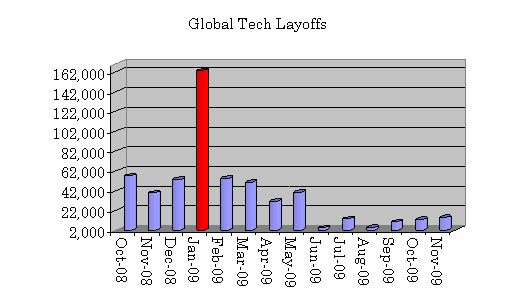
According to my information, nearly 550,000 tech-related jobs have been eliminated since October 2008. January 2009 saw almost 164,000 jobs eliminated by the biggest names in tech. Ericsson. Google, IBM, Intel, Microsoft, NEC, and Sprint-Nextel all eliminated 5,000 or more jobs in January 2009. While this is old news, unless you are still trying to live through one of these “right-sizing” it is also important because we are coming back around to the lay-off season.

Global Tech Layoffs

This year’s lay-off season is trending up after several months of decline. From a record high in January tech layoffs declined to a modest 4,336 layoffs in June 2009. Since reaching that bottom the tech layoff rate has increased to levels not seen since May 2009. August 2009 had almost 5,000 layoffs. The number of layoffs in September doubled to 10,246. The trend has been increasing since with 12,704 layoffs in October and in the first half of November, there have been already been 12,749 layoffs. Some of the same firms that had “resource reduction actions” in January had laid off more people in November, including Ericsson (700), Microsoft (800), and Sprint-Nextel (2,500).

Tech Layoffs Last Quater 2009

It appears to me that despite Wall $treet bonus’. the rest of us are still in for at least 12 more months of questionable job prospects


Ralph Bach has been in IT long enough to know better and has blogged from his Bach Seat about IT, careers, and anything else that catches his attention since 2005. You can follow him on LinkedInFacebook, and Twitter. Email the Bach Seat here.