The U.S. Labor Department recently reported that the unemployment rate held steady at 9.5%. The analysts at Chart of the Day crunched some numbers and it looks like the U.S. is not out of the economic woods yet. According to Chart of the Day, assuming that the depression, economic uncertainty, recession ended in June 2009, the current unemployment rate is exactly where it was at the end of the recession (9.5%). They offer some perspective on the current state of the job market, their chart illustrates the amount of time it took for the unemployment rate to ultimately dip below (and stay below) its recession-end level for each recession since the late 1940s.
 For example, at the end of the recession that ended in November 1982, the unemployment rate stood at 10.8%. As the chart illustrates, it took two months for the unemployment rate to drop below (and stay below) the recession-end level of 10.8%.
The Economic Policy Institute (EPI) pointed out last March that to absorb the nearly 15 million officially unemployed workers in this country, plus the roughly 2.6 million “marginally attached” workers (jobless workers who want a job but have given up actively seeking work and are not counted as officially unemployed), job openings and hiring must rebound dramatically.
 The latest EPI numbers say that for every job filled, there are still 5 people who cannot find a job. In this environment of constant right-sizing, resource actions, mass-hiring, firms are stockpiling cash and not making things. The cash stock-piles are huge. The BusinessInsider has this graphic which says it all in my opinion.
Bloomberg reported in February that a majority of companies in the Standard & Poor’s 500 stock index increased cash to a combined $1.18 trillion while simultaneously reducing spending, keeping a jobs recovery on hold. Bloomberg reports that firms  such as:
- Caterpillar Inc.
- Eaton Corp.
- Walgreen Co.
- General Electric Co.
are among 256 companies that ended last quarter with billions more cash than a year earlier after cutting capital spending by 43 percent. Bloomberg economists say the dearth of investment is keeping the jobless rate at about 10 percent.
According to a Washington Post article, non-financial companies are sitting on $1.8 trillion in cash, roughly one-quarter more than at the beginning of the recession. The Post sites a survey of more than 1,000 chief financial officers by Duke University and CFO magazine showed that nearly 60 percent of those executives don’t expect to bring their employment back to pre-recession levels until 2012 or later — even though they’re projecting a 12 percent rise in earnings and a 9 percent boost in capital spending over the next year.
 It is noteworthy that, over the past two decades, it has taken much longer (on average) for the unemployment rate to drop below its recession-end level. The reasons for this increased time for the unemployment rate to turn around varies. One explanation that Chart of the Day offers is that following World War II, the US found itself in a strong/dominant economic position. It took time, but eventually many of the remaining world economies began to recover and we are now witnessing increased competition as a result of the rise of the rest.

If it is globalization or corporate greed, the lack of jobs in the U.S. means 80% of job seeks are out of luck. “The 5-to-1 ratio means that there is literally only one job opening for every five unemployed workers. That is, for every four out of five unemployed workers there simply are no jobs” explains EPI economist Heidi Shierholz.
Ralph Bach has been in IT long enough to know better and has blogged from his Bach Seat about IT, careers, and anything else that catches his attention since 2005. You can follow him on LinkedIn, Facebook, and Twitter. Email the Bach Seat here.


 It has been just over a year since Wall $treet and the Bankers lead the global economy to the edge of collapse. Thanks to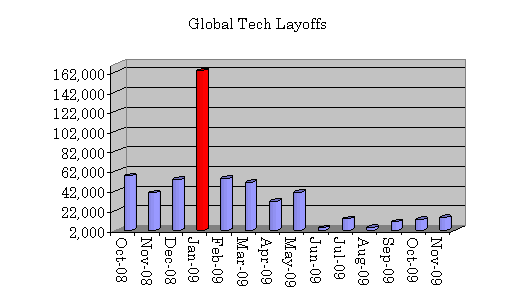

 The
The 
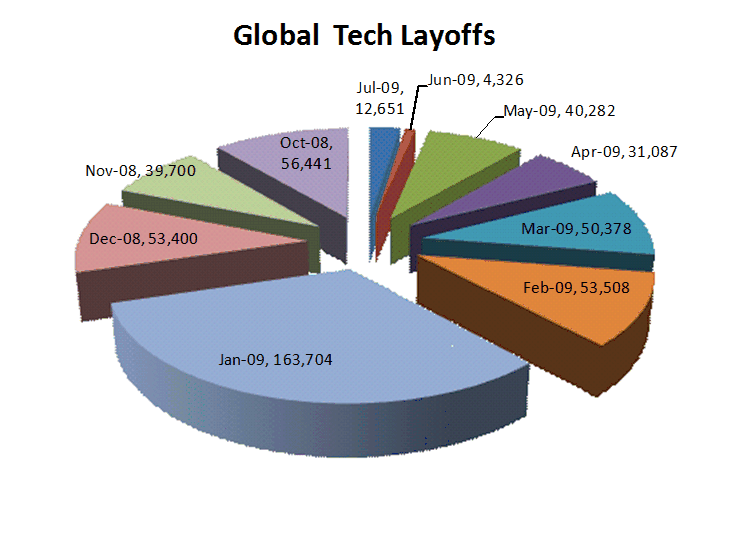
 The global body count in the tech sector has risen above 500,000 in July 2009. Since the