Tag Archive for Recession

Global Tech Layoffs Pass Half a Million

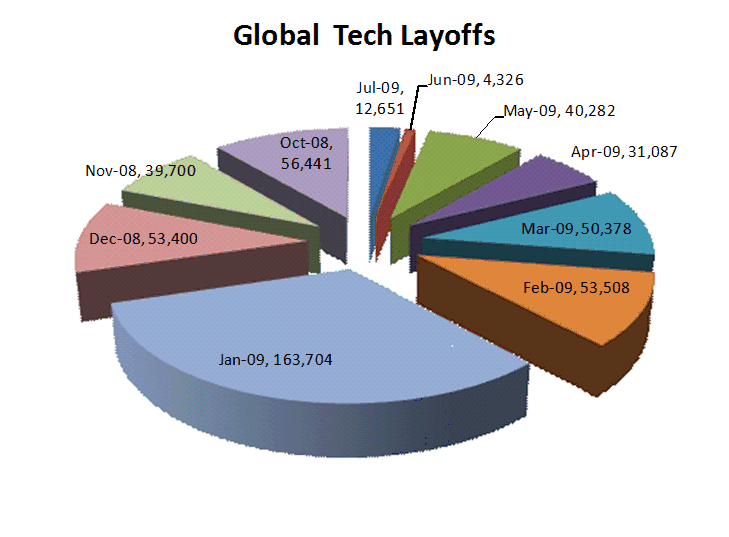
The global body count in the tech sector has risen above 500,000 in July 2009. Since the correction, recession, economic melt-down started in earnest in October 2008, about 505,477 tech-related jobs have been right-sized, down-sized, resource actions eliminated. January 2009 is the worst month for employees with nearly 164,000 tech jobs eliminated. October 2008 saw over 56,000 workers pink-slipped. Approximately 53,500 tech workers we laid off in both December 2008 and February 2009. The last two months have shown a decline in the numbers of tech workers getting the ax. In June 2009, 4,326 workers were laid off, the smallest monthly count since the economic meltdown started. July 2009 witnessed 12,65 layoffs, most from Verizon. The July count is also well below the average 50,000 lay-offs a month pace being set during the economic meltdown.Global Tech Layoffs
rb-

These numbers say to me that we are still in for a long hard year before anything like a real turn-around emerges. So despite what Newsweek says, the recession is not over.

Among the firms that generated these layoffs are:


Ralph Bach has been in IT long enough to know better and has blogged from his Bach Seat about IT, careers, and anything else that catches his attention since 2005. You can follow him on LinkedInFacebook, and Twitter. Email the Bach Seat here.

Server Sales Slide

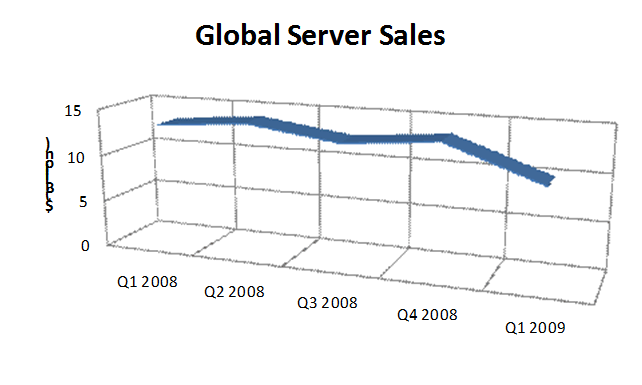
Server Sales SlideLike most of us (except the bankers) global sales of servers have taken a beating since the first quarter of 2008. Server sales have declined by over $3 billion due to the economic slowdown meltdown recession and the growth of virtualization. Today, the global server market stands below $10 billion.

Global Server Sales

IBM logoSince Q1 of 2008 IBM‘s server revenues have declined over $1 billion from $3.946 billion to $2.913 in Q1 2009. Big Blues’ market share also declined from 30% to 29.3% during the same period. On the other hand, HP (HPQ) revenues grew from $2.904 billion to $3.624 billion and grew their market share to 29.3%, matching IBM in Q1 2009. Dell’s (DELL) revenues dropped from  $1.590 billion in 2008 Q1  with a 12.1% market share to revenues of $1.093 billion and an 11% market share in Q1 2009.

HP logoAccording to the ChannelInsider article:

  • No quick recovery for server sales until the general economy recovers (CI)
  • End-users continue to extend the life of existing servers (CI, other sources)
  • Servers remain among the least profitable for solution providers (CI: Market Pulse)
  • Demand for conventional and blade servers by end-users continues to shrink (CI: Market Pulse)
  • The popularity of data center virtualization technologies have had the collateral effect of shrinking server hardware demand (CI)

Ralph Bach has been in IT long enough to know better and has blogged from his Bach Seat about IT, careers, and anything else that catches his attention since 2005. You can follow him on LinkedInFacebook, and Twitter. Email the Bach Seat here.

Tech Layoffs Continue to Mount

Tech Layoffs Continue to Mount351,202 families’ lives have been disrupted in the tech sector since October 2008, when the banks lead us into the current depression recession economic downturn.  32,820 layoffs have been announced in the tech sector during March 2009.

The tech layoff leaders for March 2009

The March total is the lowest since the depression recession economic downturn started.

  • February 2009 = 48,064
  • January 2009 = 150,014
  • December 2008 = 36,278
  • October 2008 = 50,204

This does not include the chaos the President Obama’s abandonment of the working class, by sending GM and Chrysler into likely bankruptcy. We are seeing the further dismemberment of the middle class as Chrysler has outsourced its IT to India’s  Tata Consultancy Services in “a multi-year contract” worth about $120 million.

Chrysler layoffs

Chrysler’s remaining 2,100 person information technology department, mostly in Auburn Hills, MI will immediately lose 200 salaried technology workers. The balance of the layoffs will come from the ranks of contract workers in that department. They will leave in greater numbers, but Jan Bertsch Chrysler vice president and chief information officer didn’t offer specifics in the Detroit News article.

Some employees may be hired by Tata or Computer Sciences, she said, and some work will be moved entirely off-site. According to the media, Tata will provide support, maintenance, and services that “will encompass a portion of the functional areas within Chrysler, such as Sales and Marketing and Shared Services.”


Ralph Bach has been in IT long enough to know better and has blogged from his Bach Seat about IT, careers, and anything else that catches his attention since 2005. You can follow him on LinkedIn, Facebook, and Twitter. Email the Bach Seat here.

IBM Plans Layoffs, Seeks Stimulus

IBM Plans Layoffs, Seeks StimulusIBM is planning layoffs of 5,000 high-skill U.S. workers in its Global Business Services unit, transferring some of the work they performed to India, according to media reports. The cuts will affect mainly information technology and consulting work in such areas as customer relations management and supply chain management, says Lee Conrad, national coordinator of Alliance@IBM,

IBM layoffsArmonk NY-based IBM has been eliminating U.S based jobs for many years. IBM has previously reduced U.S. employment by 6,000 workers in 2008. Since 2003, the company has hired approximately 90,000 people in India and more than 5,000 in Brazil to do IT and business-process outsourcing [BPO] services work.

IBM is working to secure pieces of the give-away American Recovery and Reinvestment Act of 2009 $787 billion stimulus measure enacted in February. IBM CEO Samuel J. Palmisano was one of 13 executives who met with President Barack Obama in January in an appearance aimed at pressuring the House of Representatives to pass the economic stimulus bill. IBM is seeking a share of the $8 billion the U.S. plans to spend on high-speed rail and part of the $20 billion in the stimulus plan to digitize the U.S. healthcare system. as well as resurrecting BPL as earlier noted here The give-away American Recovery and Reinvestment Act of 2009 includes $11 billion to be spent on ‘smart grid‘ systems to monitor and manage the nation’s electrical network.

he American Recovery and Reinvestment Act of 2009 (ARRA)According to CIO Today, some economists have estimated that taxpayers are paying an average of $225,000 for each job created in the economic stimulus package. According to Martin Kenney, a professor of political economy at the University of California, Davis,: “Taxpayers are saying, ‘I don’t want to give them money if they’re moving jobs offshore.'”

rb-

The give-away American Recovery and Reinvestment Act of 2009 is turning out to be a $787 billion bailout of dubious firms like AIG and IBM and just keeps getting worse and worse for those of us who still work in America.


Ralph Bach has been in IT long enough to know better and has blogged from his Bach Seat about IT, careers, and anything else that catches his attention since 2005. You can follow him on LinkedInFacebook, and Twitter. Email the Bach Seat here.

Copper Prices Headed Up Again

Copper Prices Headed Up AgainCopper prices are on the upswing again and could be taking the cost of low voltage cabling with it. According to an article from MarketWatch. Copper (Cu)  finished 2008 at about half the price it started with, but lately, it’s been rising thanks to China’s 4 trillion yuan ($585 billion) stimulus plan. The Chinese stimulus plans are expected to kick in later this year and through to 2010 in “massive infrastructure projects,” according to Martin Hayes, an analyst at BaseMetals.com. Those projects “will use significant tonnage of base metals, including copper.”

Copper’s “often called ‘Doctor Copper’ because it takes the temperature of the global economy,” said Sean Brodrick, a natural-resources analyst at UncommonWisdomDaily.com. “According to Doctor Copper, things are improving, mainly due to Chinese demand.” Already, China’s imports of copper and alloys climbed 55% in February from January, said, Brodrick.

On 02-27-2009, copper prices climbed to a four-month high of nearly $1.90 per pound on the Comex division of the New York Mercantile Exchange.

CU 60 day trend

Brent Cook, the author of the investment letter Exploration Insights, argued that the recent gains in copper prices may not be fundamental demand driven by consumption. “The global building and construction market is not improving,” he said. “If anything, [it] is still getting worse — ditto automobiles.” Cook goes on, “I believe we are seeing a combination of a bear market rally, short-covering rally, and restocking by the Chinese who have a real incentive to turn their U.S. dollar into hard assets.

RB –

It was not that long ago that China’s rush up to the Beijing Olympics drove commodities such as steel, concrete, and copper way up. As I pointed out the last time Cu took off, it impacts the cost of telecommunications cables and the cost of new projects. I believe that Exploration Insights Cook is right that this current run-up is part of the Chinese effort to convert the one trillion of US debt they own to something else.

China’s premier, Wen Jiabao, recently expressed concern about the safety of China’s $1 trillion investment in American government debt, the world’s largest such holding, and urged the Obama administration to give assurances that its investment would keep its value in the face of a global financial crisis. “We have lent a huge amount of money to the U.S. Of course we are concerned about the safety of our assets,” Wen told reporters. “To be honest, I am definitely a little worried.” (www.uncommonwisdomdaily.com/)

At least this run-up is not accompanied by a surge in oil prices like in 2007. For all of our sake’s let us hope that Cu is a leading indicator of a growing economy.


Ralph Bach has been in IT long enough to know better and has blogged from his Bach Seat about IT, careers, and anything else that catches his attention since 2005. You can follow him on LinkedInFacebook, and Twitter. Email the Bach Seat here.