F.C.C. Clears Internet Access by Power Lines, NY Times, Stephen Labaton
WASHINGTON, Oct. 14 – Clearing the way for homes and businesses to receive high-speed Internet services through their electrical outlets, the Federal Communications Commission adopted rules on Thursday that would enable the utility companies to offer an alternative to the broadband communications services now provided by cable and phone companies.
As a further spur to the roll-out of broadband Internet services, the F.C.C. also ruled that the regional Bell companies do not have to give competitors access to fiber optic lines that reach into consumers’ home – a decision that prompted two of the Bells, SBC Communications and BellSouth, to announce that they would move quickly to build new fiber optic networks in residential neighborhoods. The ruling was criticized by rivals of the Bells and consumer groups, which called it anti-competitive and said it would lead to higher prices.
For the electric companies’ part, broadband Internet service is more than a year away from becoming widely available. But the agency’s ruling is expected to increase significantly the level of investment and interest by the utilities, which had been stymied in previous attempts to offer new services over power lines. Power lines reach more American homes than either telephone lines or television cables.
So far, the technology has been limited mainly to experiments around the country, although a commercial version recently became available in some communities near Cincinnati.
“Today is a banner day, and I think years from now we will look back and see it as a historical day for us,” said Michael K. Powell, the F.C.C.chair. “This is groundbreaking stuff.”
Known as broadband over power lines, or B.P.L., the technology uses a special modem that plugs into electrical outlets. So far, it has been offered at speeds of 1 to 3 megabits a second, which is comparable to broadband service over cable modems or conventional phone lines – though not as fast as the 5 megabits a second achievable through the residential fiber-optic lines just now being introduced by the Bell companies.
An obstacle to the use of power lines to carry communications traffic has been the electromagnetic interference the technology can cause to various types of radio signals. The commission ruled that it would tolerate a small amount of radio interference in certain areas by the new service in exchange for making the broadband market more competitive.
Amateur radio operators and public safety officials had asked the commission to move slowly in the area because of the interference created by the service. The agency responded by setting up a system to monitor interference and restricting the service in areas where it could jeopardize public safety, like areas around airports and near Coast Guard stations.
Officials noted that there have already been field tests in 18 states of the B.P.L. technology. One company, Current Communications, has recently begun to offer broadband service near Cincinnati in a joint venture with Cinergy, the Midwest power and energy company. The service is priced at $29.95 to $49.95 a month, depending on the speed.
While some regulatory and technical issues remain, the technology offers enormous promise because the power grid is ubiquitous. The costs to the industry to offer the new service would be comparatively small, and the possible returns on those investments could be high. If the utility companies do begin to offer the broadband service more widely, they would also be likely to enter the telephone business by offering phone services over the Internet, just as phone and cable companies have begun to do.
Mr. Powell, the F.C.C. chair, said that the new technology would not only offer greater competition in the broadband market but would also allow consumers to easily create networks in their homes through electrical outlets. And adding communications abilities to power lines would permit electric companies to better manage the power grid, he said.
Mr. Powell and three other commissioners voted to approve the rules. The fifth commissioner, Michael J. Copps, dissented in part. He noted that the agency had pushed aside a number of vital issues for another day, including questions of whether utility companies would have to contribute to the telephone industry’s universal service fund and provide access to people with disabilities, and whether measures would be put in place to ensure market competition.
He also said that regulators would need to determine whether it would be fair for electricity customers to pay higher bills “to subsidize an electric company’s foray into broadband.”
“We just have to get to the big picture and confront the challenges I have mentioned if B.P.L. is going to have a shot at realizing its full potential,” Mr. Copps said.
But industry executives praised the decision.
“This is one of the defining moments for the widespread adoption of broadband by Americans,” said William Berkman, chairman of Current Communications, a private company in Germantown, MD, which hopes to have in place a B.P.L. Internet network passing by 50,000 homes by the end of the year. The future also grew brighter for the regional Bell companies with the F.C.C.’s decision to grant BellSouth’s request to exempt the Bells from any requirement that they lease their new fiber lines to the home to rivals at low costs.
Mr. Powell said that the exemption would “restore the marketplace incentives of carriers to invest in new networks.”
Prompted by the decision, the Bells said they would move more rapidly to build fiber networks to homes. So far, the nation’s biggest Bell, Verizon Communications, has been the most active in building residential fiber networks. But on Thursday, SBC said it now planned to provide 18 million households higher speed Internet services in two to three years, rather than five years as previously announced.
“The shovel is in the ground, and we are ready to go,” said SBC’s chairman and chief executive, Edward E. Whitacre Jr.
But rivals, consumer groups, and Mr. Copps criticized the decision as anti-competitive.
The F.C.C. majority seems unable to restrain its preference for monopoly over America’s consumers, business users, and investment, said Len Cali, a vice president for AT&T.
Mark Cooper, director of research at the Consumer Federation of America, said the decision would tighten the already powerful grip that the telephone and cable companies have on broadband services.
“This stranglehold will stifle innovation as these duopolies discriminate against unaffiliated applications and services that in the past have driven the growth of the Internet and the boom in information technology,” Mr.Cooper said.
Ralph Bach has been in IT long enough to know better and has blogged from his Bach Seat about IT, careers, and anything else that catches his attention since 2005. You can follow him on LinkedIn, Facebook, and Twitter. Email the Bach Seat here.


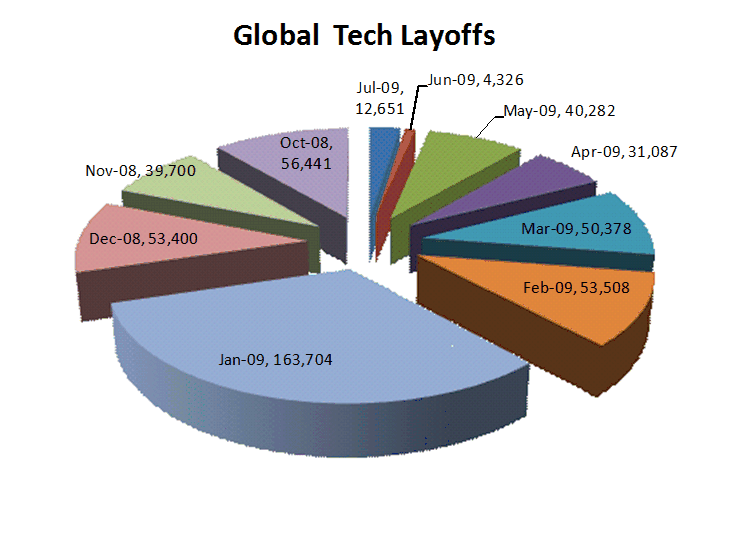
 The global body count in the tech sector has risen above 500,000 in July 2009. Since the correction, recession, economic melt-down started in earnest in October 2008, about 505,477 tech-related jobs have been right-sized, down-sized, resource actions eliminated. January 2009 is the worst month for employees with nearly 164,000 tech jobs eliminated. October 2008 saw over 56,000 workers pink-slipped. Approximately 53,500 tech workers we laid off in both December 2008 and February 2009. The last two months have shown a decline in the numbers of tech workers getting the ax. In June 2009, 4,326 workers were laid off, the smallest monthly count since the economic meltdown started. July 2009 witnessed 12,65 layoffs, most from Verizon. The July count is also well below the average 50,000 lay-offs a month pace being set during the economic meltdown.