

 The Economist wonders whatever happened to the “paperless office”? Thirty years ago computers were hailed as the beginning of the paperless office era. In 1980 The Economist recommended that firms trying to improve productivity “reduce the flow of paper, ultimately aiming to abolish it”.
Unfortunately not many people listened to The Economist. Since they extolled the virtue of a paperless office, global paper consumption has increased by half.

The average American uses almost six 40-foot trees a year in paper. Gizmodo says don’t feel too bad. The EU bureaucracy in Brussels pushed the Belgian paper consumption to a whopping 8.5 trees per person. The equivalent to four Rockefeller Center Christmas trees.
Paperless office research says
The trend will not change. A report from ITnewsLink reports that more than half of Americans think the U.S. will never go paperless. Pollster Poll Position conducted a national survey to see if Americans think the U.S. could ever be a paperless society.
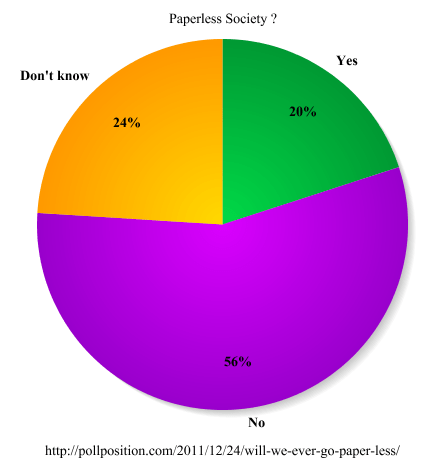 Poll Position’s research found that 56% of Americans said they don’t think the U.S. would ever be a paperless society. Only 20% said yes, one day we’ll all go paperless. 24% of Americans were undecided or had no opinion on the question.
Other Poll Position finding
- 63% of the 18-29 age group said the U.S. would never be a paperless society and 23% said we could be a paperless society.
- 56% of men and women said we could never be a paperless society.
- 58% of Republicans and 51% of Democrats believed we would never be a paperless society.
You can still vote in their online companion poll.
rb-
I think that in an era of computers, Amazon (AMZN) Kindle Fire and Apple (AAPL) iPad tablet computers, iPhones and Google (GOOG) Android smartphones that paper consumption would decrease. Apparently it takes more than buzzwords like “paperless” and “green” to make a difference.
Related articles
- The Paperless Office? (Going Green) (whattheythink.com)
Ralph Bach has been in IT long enough to know better and has blogged from his Bach Seat about IT, careers and anything else that catches his attention since 2005. You can follow him at LinkedIn, Facebook and Twitter. Email the Bach Seat here.