
Tag Archive for Kindle

Tablet Info

ComputerWorld defines post-PC devices like a tablet with four characteristics;
1. It’s an appliance.
2. It’s got a multi-touch UI,
3. It doesn’t have file management,
4. Apps function on the app-store model.

Big Drop in Tablet Average Selling Price

Big Drop In The Average Selling Price Of TabletsThe Business Insider has documented the average selling price (ASP) of tablets keeps falling. The ASP fell 17 percent from 2010—when it was pretty much just the Apple (AAPL) iPad—to 2011. Through the first six months of this year alone, the ASP has fallen another 17 percent.

The drop is driven partly by the introduction of $200 mini tablets like the Amazon (AMZN) Kindle Fire, but also a fall in the price of the dominant large-screen devices.

rb- No wonder Apple is suing everybody in sight to prevent competition. They need to protect their profit margins. Way to go USPTO.

Tablet Average Selling Price

Are We in the Post PC Era

Are We in the Post PC EraKevin C. Tofel at GigaOM recently wrote that by looking at the numbers, it’s difficult to argue that the Apple (AAPL) iPad is anything less than a success. The company sold more iPads — 15.4 million — than any traditional computer maker sold PCs in the last quarter of 2011. Mr. Tofel argues what is debatable, however, is whether the iPad will take us to the “post-PC” era, as Apple calls it. Former Apple director Michael Mace suggests that the PC isn’t going away, agreeing with Apple’s CEO, Tim Cook, who recently saidI don’t predict the demise of the PC industry, I don’t subscribe to that.

Michael Mace observed on his personal blog that. “I think the ‘PC era’ meme from Apple is self-serving hype. Of course, they want to convince you that the world is shifting away from a market where Apple has less than 10% worldwide share to a market where Apple has well over 50% share.

“... My thought is that PCs aren’t going to suddenly disappear, but people will continue to opt for capable tablets or hybrid devices in the place of future, new PC purchases. The mobile market is shifting traditional tasks away from PCs of old, and for people who need a PC occasionally, they will likely be able to access one remotely.

Apple is simply calling out the post-PC era because it has successfully transformed its business lines ahead of the curve and before its peers.

Mr. Tofel points out that when all is said and done, Mace makes one last salient point worth noting: How will Microsoft (MSFT) respond to the iPad? We know the answer is Windows 8, but there’s still an open question about how well the platform will do on tablets. Perhaps, Mace notes, we’re not exactly on the cusp of a post-PC age, but instead, a post-Microsoft era.

Related articles:

  • Amazing Stats from Apple Q3 Earnings Prove Yet Again We’re In A Post-PC Era

Magic Cable Trio All-in-One USB Simplicity

Magic Cable Trio All-in-One USB SimplicityTested.com points out the handy Innergie Magic Cable Trio which solves an age-old problem. You never have the right USB connector when you need it. The Magic Cable Trio combines mini USB, micro USB, and 40-pin dock tips into a single cable. The handy-dandy cable will play ball with your tablet, or just about any USB device you can get your hands on according to Tested. It won’t work with printers, but the Magic Cable Trio is meant for plug-and-play accessibility, not languishing behind a desk collecting dust.

The tips are all attached and fold out-of-the-way when not in use. Tested says the extra tips could be a bit of a nuisance, but you’ll never have to worry about losing the adapters in the bottom of a backpack. The Magic Cable Trio costs $20 at Innergie’s store.Innergie Magic Cable Trio

Related articles

Polycom on iPad

Polycom logoAnalysts are forecasting that the tablet market will grow five-fold by 2015 to 320 million units sold annually. The cumulative number of tablets in use by that point will be about 900 million. Many are predicting that the tablet will continue to gain in functionality and take over the laptop in the coming years.

Polycom is pioneering high-definition video collaboration for tablets called Polycom® RealPresence™ Mobile. Polycom RealPresence Mobile is the first enterprise tablet software that lets mobile users enjoy HD video collaboration from anywhere. It is available now on the Apple (AAPL) iPad 2, MotorolaXOOM, and Samsung (005930) Galaxy Tab 10.1—with more mobile devices to follow.

RealPresence Mobile extends Polycom’s HD video collaboration technology beyond the office and conference room. Iy bringing a high-quality, secure, reliable experience to tablets that is comparable to desktop and room systems.

RealPresence Mobile delivers enterprise video collaboration for the business tablet market and delivers provisioning, management, system interoperability, firewall traversal, and scalability that CIOs need, and the reliability, security, rich features, and lifelike quality that users demand.

RealPresence Mobile scales, supporting up to 75,000 devices and 25,000 concurrent calls.

You can find download a free end-user application from the Apple Store, Android Market, and Samsung Apps.

Related articles


Ralph Bach has been in IT long enough to know better and has blogged from his Bach Seat about IT, careers, and anything else that catches his attention since 2005. You can follow him on LinkedInFacebook, and Twitter. Email the Bach Seat here.

What Happened to the Paperless Office?

What Happened to the Paperless Society?The Economist wonders whatever happened to the “paperless office”? Thirty years ago computers were hailed as the beginning of the paperless office era. In 1980 The Economist recommended that firms trying to improve productivity “reduce the flow of paper, ultimately aiming to abolish it”.

Unfortunately not many people listened to The Economist. Since they extolled the virtue of a paperless office, global paper consumption has increased by half.

Paper consumption

The average American uses almost six 40-foot trees a year in paper. Gizmodo says don’t feel too bad. The EU bureaucracy in Brussels pushed the Belgian paper consumption to a whopping 8.5 trees per person. The equivalent to four Rockefeller Center Christmas trees.

Paperless office research says

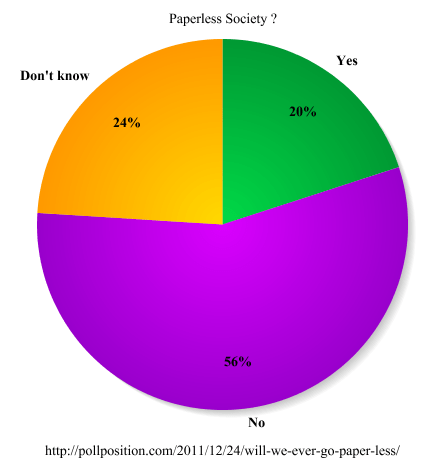
The trend will not change. A report from ITnewsLink reports that more than half of Americans think the U.S. will never go paperless. Pollster Poll Position conducted a national survey to see if Americans think the U.S. could ever be a paperless society.

Poll Position researchPoll Position’s research found that 56% of Americans said they don’t think the U.S. would ever be a paperless society. Only 20% said yes, one day we’ll all go paperless. 24% of Americans were undecided or had no opinion on the question.

Other Poll Position finding

  • 63% of the 18-29 age group said the U.S. would never be a paperless society and 23% said we could be a paperless society.
  • 56% of men and women said we could never be a paperless society.

You can still vote in their online companion poll.

rb-

I think that in an era of computers, Amazon (AMZN) Kindle Fire and Apple (AAPL) iPad tablet computers, iPhones and Google (GOOG) Android smartphones that paper consumption would decrease. Apparently it takes more than buzzwords like “paperless” and “green” to make a difference.

Related articles
  • The Paperless Office? (Going Green) (whattheythink.com)


Ralph Bach has been in IT long enough to know better and has blogged from his Bach Seat about IT, careers and anything else that catches his attention since 2005. You can follow him at LinkedInFacebook and Twitter. Email the Bach Seat here.

Tablets Notes

Forrester Report Casts Doubt on iPad Competitors

Tablets NotesThe New York Times cites a recent Forrester (FORR) report on the state and near future of the tablet marketplace titled “iPad Challengers Have Flawed Product Strategies.”

The report’s main conclusion was that Apple’s (AAPL) iPad competitors have not addressed pricing, distribution, and product differentiation adequately to make a case to consumers.

  1. The new tablets are too expensive. Apple has, unexpectedly, kept iPad prices comparatively low. The Motorola (MSI) Xoom starts at $100 more than the iPad and Samsung’s Galaxy Tab can be had for $250, but that does not include a two-year contract with a mobile carrier. Someone should be coming in to undercut this market, but that has proved harder than it looks.
  2. The wrong stores are selling tablets. Forrester’s research shows that one of the least desirable places to buy a tablet is at a cellphone store. But many tablet makers continue to rely on wireless carriers as a primary retail channel, which Forrester’s report concludes is a bad bet.
  3. The new tablets are not distinguished enough.  The average user does not care about specs because it’s about the apps that run on these toys.
  4. The new tablets are not Windows. Forrester’s survey said the number one operating system people want on a tablet is Windows. If Microsoft (MSFT) is not going to release a true tablet-ready OS until late-summer 2012, those who want a Windows tablet may have to wait for two generations of tablets.

Forrester speculates that an Amazon (AMZN) tablet could change the market. Amazon could offer more attractive terms to media partners than Apple. It already has scads of credit-card numbers for easy one-click app purchases. It has media offerings like streaming video. It now has some experience designing, marketing, and selling its own hardware with the Kindle.

Cisco Cius

CiscoDoes anyone remember Cisco’s Cius? In case you don’t No Jitter has an article from June 2010 by Zeus Kerravala of the Yankee Group. The Cius was purported to be a tablet that can dock into a base station and can act as a video phone. When undocked the device operates like a tablet computer that can be carried around and shared between workers.

Mr. Kerravala says the Cius tablet isn’t really meant to be a replacement for a laptop or an Apple (AAPL) iPad type of tablet. It’s a communications-centric tablet that can provide an easy interface into vertically specific applications, make videoconferencing portable and create a new way for people to interact with one another. The Cius will be centered on visual communications and not productivity applications like word processing and spreadsheets.

The Cius uses  Google’s (GOOG) Android operating system, perhaps to attract developers. The article says the Cisco (CSCO) of a few years ago would have chosen to build its own interface. Android is a key to the success of Cius. The likelihood of developers building applications for an Android-based Cisco device is higher than developers creating applications for a Cisco operating system.

According to the article, the Cius is to be priced under $1,000, comparable to a high-end Cisco IP phone. While no network operator partners were announced at the time, Cisco said that the device was WiFi, 3G, and 4G capable.

Are the End Days Nearing for PCs (and Macs)

GigaOm‘s Ryan Kim recently wrote that the glory days of the PCs are fading with the rise of more nimble smartphones and tablets. Wi-Fi provider JiWire confirmed this trend over the Christmas holidays. JiWire, which operates 35,000 public Wi-Fi hot-spots in the U.S., saw new iPad connections increase by 33.8 percent and new Android (GOOG) users were up 47.9 percent while new Mac users were down 28.1 percent and new PC connections were down 12 percent over the Christmas holidays. Mr. Kim writes that this trend marks people’s dependence on computers is waning as they find more utility and portability in smartphones and tablets.

This trend is shaking up the computer world according to GigaOm. Gartner (IT) recently predicted that PC sales would decline 10% in the face of increased tablet sales. And as mobile networks ramp up to 4G and Wi-Fi usage grows, it’s only fueling the interest in mobile devices. This is a major shift that is forcing all the big players to adjust. The author points out that:

  • Microsoft (MSFT) re-entered the smartphone game at CES 2011 with Windows Phone 7 with Windows OS on ARM (ARMH) designed chips.
  • Intel (INTC) is working hard to get its chips to run on mobile devices though it’s still an uphill battle displacing ARM-designed chips.
  • HP (HPQ) bought Palm last year and is prepping a line of WebOS tablets and smartphones.

Apple (AAPL) is forcing these changes on the industry according to Mr. Kim. the iPhone and the iPad made mobile computing more user-friendly. Apple CEO Steve Jobs predicted that overall PC usage would decline and suggested that lightweight devices like the iPad would do most of the tasks people needed. GigaOm says that companies that embrace this new reality, are the ones best positioned for the future. The new iFuture means PC manufacturers will have to accept that the switch to mobile devices may come at the cost of traditional computer sales. The article concludes that manufacturers can let someone else lure their PC customers away with a tablet or smartphone or they can build one themselves.

Tablets Are Hammering The Notebook Market: Acer Sales Off 10%

The BusinessInsider reports that Acer (ACEIY) has warned that its 2011 Q1 sales will be off 10%. The Taiwanese PC maker is blaming Apple’s iPad and it tablet cousins for devastating its key netbook business.

Related articles

Ralph Bach has been in IT long enough to know better and has blogged from his Bach Seat about IT, careers, and anything else that catches his attention since 2005. You can follow him on LinkedInFacebook, and Twitter. Email the Bach Seat here.
Privacy Day 2010

Privacy Day 2010Data Privacy Day is January 28, 2010.  Data Privacy Day is an international celebration of the dignity of the individual expressed through personal information according to its sponsors. In this networked world, in which we are thoroughly digitized, with our identities, locations, actions, purchases, associations, movements, and histories stored as so many bits and bytes, we have to ask – who is collecting all of this – what are they doing with it – with whom are they sharing it?

For its part, Google (GOOG) has released a video highlighting the ways it uses some of that personal data it collects about you to make your life easier and then explains that you can opt-out of some of Google’s data collection policies.

Nicrosoft logoMicrosoft (MSFT) has released the results of a study on data privacy.  According to the Microsoft survey, the results illustrate how we, as a society, are still grappling with the intersection of privacy and online life. For example, 63 percent of consumers surveyed are concerned that online reputation might affect their personal and/or professional life, yet, less than half even consider their reputations when they post online content.

Finally, Fewer than 15%  of consumers in any of the countries surveyed believe that information found online would have an impact on their getting a job.  The Microsoft study found 70% of surveyed HR professionals in the U.S. have rejected a candidate based on online reputation information. Reputation can also have a positive effect as in the United States, 86% of HR professionals stated that a positive online reputation influences the candidate’s application to some extent; almost half stated that it does so to a great extent.

Electronic Frontier FoundationFor its part, the Electronic Frontier Foundation (EFF) has published, “The E-Book Buyer’s Guide to Privacy ” which outlines six elements of Ebook readers’ privacy policies:

The EFF surveyed the policies and found that Google Books and Amazon Kindle will monitor what you’re reading. The EFF also found that all the E-book readers will keep track of book searches and book purchases.  The Kindle, Nook, and Reader shared information collected on your book selections, searches, and purchases is shared outside the company without your consent. The good news is that the a free, open-source FBReader (for Windows/Linux) does not collect data on your book selections or searches.

Google Books and Amazon Kindle will monitor what you're readingThese privacy issues are important for citizens and businesses. Firms have to consider whether they are complying with laws and regulations requiring consumer privacy protections. They know that customers have to trust their technologies and services before they will use and pay for them.


Ralph Bach has been in IT long enough to know better and has blogged from his Bach Seat about IT, careers, and anything else that catches his attention since 2005. You can follow him on LinkedInFacebook, and Twitter. Email the Bach Seat here.