Tag Archive for 2009

Data Destruction Policy Suggestions

Data Destruction Policy SuggestionsHumans have created more digital information than we have the ability to store according to EMC‘s digital universe survey. ComputerWorld recently published an excellent article with a lawyer’s point of view about data destruction. Attorney Mark Grossman is a tech lawyer and the founder of the Grossman Law Group and Tate Stickles a partner in the Grossman Law Group offers some insight for creating an effective data destruction policy.

Highlights of a data destruction policy

  1. Data destruction is intended to be permanent.
  2. Policies must be consistently enforced.
  3. The goal is to identify and classify what data the firm has and create effective policies for disposing of it.
  4. Legal and proper data destruction may prevent extensive fishing expeditions by your opponents.
  5. A regular business process addressing data destruction should provide some “safe harbor” protections under the Federal Rules of Evidence relating to electronic evidence.
  6. Have a data retention policy – A data destruction policy is the second part of your data retention policy which will help decide where data is stored and make it easier to delete old data.

General rules

  1. The general rule for the disposal of any data is that simple deletion and overwriting of data is not enough.
    • When reusing media, wipe the old data, confirm that the data is gone, and then document the process then the media can be reused.
    • Media that leaves the control of the firm by destroying old media or reselling it to another party need more processes up to the physical destruction of media.
  2. Obligations to take certain data destruction steps depend on the laws, rules, or regulations that regulate the firm:
    • Sarbanes-Oxley,
    • Gramm-Leach-Bliley,
    • The Fair and Accurate Credit Transactions Act,
    • HIPAA,
    • Check with your tech attorney who can provide guidance on what laws, rules, and regulations may apply to your company’s situation.
  3. Not heavily regulated firms can look to other destruction standards:
    • U.S. Department of  Defense standards and methods (DoD 5220.22-M,
    • National Institute of Standards and Technology’s Guidelines for Media Sanitation (NIST SP 80-88),
    • International, national, state, and local laws, rules, and regulations.
  4. Should address how to classify and handle each type of data residing on the media.
  5. Needs a process for the review and categorization of the types of data your company has and what kinds can be removed.
  6. Classifications and contents of data will play a role.
  7. Data and media containing confidential information, trade secrets, and the private information of customers require the strictest controls and destruction methods.
  8. Data and media containing little to no risk to the firm may have relaxed levels of control and destruction.
  9. Review contracts with other companies to ensure proper handling of data destruction within the terms of those contacts. I.e., non-disclosure agreements can contain data destruction terms that must be complied with.
  10. When reselling or recycling media, take samples to make sure that the proper levels of data destruction are maintained.
  11. In-house data destruction requires verification that the data sanitation and destruction tools and equipment are functioning properly and maintained appropriately.
  12. Document the entire policy so the firm will know what media is sanitized and destroyed. The documentation should allow easy answers to who, what, where, when, why, and how questions.

The last step of an effective policy is to have a process. in place so the firm can follow up with regularly scheduled testing of the process and media to ensure the effectiveness of the policy.


Ralph Bach has been in IT long enough to know better and has blogged from his Bach Seat about IT, careers, and anything else that catches his attention since 2005. You can follow him on LinkedInFacebook, and Twitter. Email the Bach Seat here.

Wireless Electricity Gets Closer

IntelWireless Electricity Gets Closer (INTC) has been working on wireless electricity technology for several years, which I wrote about earlier, that now works over longer distances. At its Intel Research Day at the Computer History Museum in Mt. View CA, on 06-18-2009, the company showed off a new variation of the idea that power can be transmitted through the air to run a speaker without any other power source.

wireless electricityIntel now calls the technology Wireless Resonant Energy Link (WREL). Intel’s goal of the WREL project is to cut the power cord. Building on principles proposed by MIT physicists in 2006. The WREL team has lit a 60W light bulb at a range of several feet and with 70% efficiency.

WREL works in a fashion similar to the old 1970’s Memorex commercial staring Ella Fitzgerald where a singer can shatter a glass by hitting its natural frequency, at which it absorbs energy efficiently. In the case of WREL, a coil of wire with a natural frequency around 10MHz takes the place of the glass, and a similar coil takes the place of the singer.

The technology uses two flat copper coils tuned to resonate at a particular frequency. One wire releases electromagnetic energy and the other picks it up in much the same way an opera singer can shatter a wine glass by singing at just the right pitch, said researcher Emily Cooper. The wireless electricity transmission shows the efficiency of 90 percent at distances of up to a meter, she said.

Intel hopes the technology will be useful for charging devices like netbooks or smartphones in a room without wires. Intel also predicts the technology could be used within devices such as a laptop.  to replace the fallible wires that connect laptop screens through a hinge, Cooper said

rb-

Intel logoIntel admits that the next milestone for the WREL project is to build a rectifying circuit that can convert the RF power to DC power without upsetting the carefully tuned pair of coils. Intel has demonstrated they can charge a light bulb with 60W of wireless electricity which should be sufficient to charge a laptop.

However to power a laptop or charge a battery, Intel will need DC power, not a 10MHz AC signal. The need to drive down the power requirements for the next generation of computing devices is also helping drive Intel’s latest attempt to break into the UMPC process market with the Atom chips and the next-generation “Moorestown” processor which boasts lower energy consumption requirements. It is also notable that Intel has a stated long-term plan of 60watts power for mainstream desktop processors, down from a maximum consumption of 130 watts of the new Pentium Extreme Edition 840, according to Benson Inkley, a senior processor applications engineer, with Intel in an article at Tom’s Hardware.

While it seems that Intel is on a trajectory to cut the power requirements and costs of owning and operating a PC fleet, it will be a while. It is much more likely that Moorestown processors are going to be aided by the pending IEEE 802.3at POE+ specification which will allow up to at least 30W which can be used to charge devices. It is my guess that the reports of the demise of wired networking are greatly exaggerated until Intel figures out how to economically and safely deliver 60W through the vapor.

Related articles


Ralph Bach has been in IT long enough to know better and has blogged from his Bach Seat about IT, careers, and anything else that catches his attention since 2005. You can follow him on LinkedInFacebook, and Twitter. Email the Bach Seat here.

Low Cost Desktop Virtualization

Low Cost Desktop VirtualizationOn Thursday (06-18-09) LG and NComputing announced an agreement where the Korean manufacturing giant will include NComputing’s desktop virtualization hardware on a new line of LCD monitors slated for release in June 2009.

NCompNComputing logouting’s desktop virtualization product includes both a proprietary hardware access device and Vspace desktop virtualization software. The hardware piece will be integrated with the LG monitors that will enable a single PC or server to be virtualized. Two LCD sizes will be available in the U.S. on the LG SmartVine N-series line: a 17-inch and 19-inch monitor. The monitors can also be used as traditional monitors that connect using VGA.

LG logoLG is integrating the access device into these monitors themselves,” Stephen Dukker, chair and CEO of NComputing says. “So, instead of being a stand-alone, PC-like device, it becomes an all-in-one computing device, and you just plug your keyboard, mouse, and microphone into the monitor,” he says. The solution will be priced below $200 and will offer both NComputing’s L series which connects via Ethernet and the X series access device, which requires a local PC connection.

Rb-

The partnership is the next act in the migration away from desktop PCs to portable computing (laptops, netbooks, and mobile devices). The traditional PC makers don’t realize that desktop virtualization allows the owner to save money throughout the life-cycle of the device.

There are savings in upfront acquisition costs; there are operational savings by reducing the management costs and the risk of obsolescence. Long-term savings can include reduced power consumption and e-waste problems. NComputing indicates that by using LG’s monitors, customers can lower their computer hardware costs by 60%, maintenance costs by 70%, and electricity costs by 90%.

The combined capabilities of the two firms should make the rest of the industry take notice of their progress (or lack). LG shipped more than 15 million monitors in 2008, and NComputing claims over a million seats sold in over 140 countries. NComputing won the Wall Street Journal Technology Innovation award, the Gartner Cool Vendor Award, and the Frost and Sullivan Green Computing award. NComputing CEO Stephen Dukker was previously co-founder and CEO of low-cost PC maker eMachines.


Ralph Bach has been in IT long enough to know better and has blogged from his Bach Seat about IT, careers, and anything else that catches his attention since 2005. You can follow him on LinkedInFacebook, and Twitter. Email the Bach Seat here.

Server Sales Slide

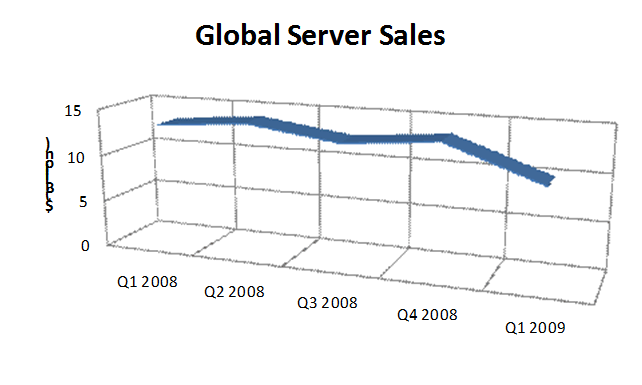
Server Sales SlideLike most of us (except the bankers) global sales of servers have taken a beating since the first quarter of 2008. Server sales have declined by over $3 billion due to the economic slowdown meltdown recession and the growth of virtualization. Today, the global server market stands below $10 billion.

Global Server Sales

IBM logoSince Q1 of 2008 IBM‘s server revenues have declined over $1 billion from $3.946 billion to $2.913 in Q1 2009. Big Blues’ market share also declined from 30% to 29.3% during the same period. On the other hand, HP (HPQ) revenues grew from $2.904 billion to $3.624 billion and grew their market share to 29.3%, matching IBM in Q1 2009. Dell’s (DELL) revenues dropped from  $1.590 billion in 2008 Q1  with a 12.1% market share to revenues of $1.093 billion and an 11% market share in Q1 2009.

HP logoAccording to the ChannelInsider article:

  • No quick recovery for server sales until the general economy recovers (CI)
  • End-users continue to extend the life of existing servers (CI, other sources)
  • Servers remain among the least profitable for solution providers (CI: Market Pulse)
  • Demand for conventional and blade servers by end-users continues to shrink (CI: Market Pulse)
  • The popularity of data center virtualization technologies have had the collateral effect of shrinking server hardware demand (CI)

Ralph Bach has been in IT long enough to know better and has blogged from his Bach Seat about IT, careers, and anything else that catches his attention since 2005. You can follow him on LinkedInFacebook, and Twitter. Email the Bach Seat here.

Cut Calories While Computing

-Updated 05-13-2010– The print edition of BusinessWeek included the Walkstation in an article in which professor Galen Cranz at UC-Berkley says, “Short of sitting on a spike, you can’t do much worse than a standard office chair.”

Cut Calories While ComputingThe Walkstation, by Michigan-based Steelcase, is a combination of a fully integrated electric height-adjustable work surface with an exclusively engineered, low-speed commercial-grade treadmill that allows users to burn calories, feel healthier, and be more energized all while accomplishing the work they normally do while seated.

Steelcase Sit to Walk Workstation

The Walkstation (video) with a maximum speed of 2 mph, lets you walk comfortably while keeping up with work. The Walkstation is based on the NEAT (non-exercise activity thermogenesis) research of Dr. James Levine of the Mayo Clinic.

Related articles


Ralph Bach has been in IT long enough to know better and has blogged from his Bach Seat about IT, careers, and anything else that catches his attention since 2005. You can follow him on LinkedInFacebook, and Twitter. Email the Bach Seat here.