Tag Archive for Apple

‘Personal Cloud’ to Replace PC by 2014, Says Gartner

‘Personal Cloud’ to Replace PC by 2014, Says GartnerMike Barton wrote on Wired’s Cloudline that there’s no doubting the cloud invasion. But the research firm Gartner (IT) believes the personal cloud will replace the PC as the center of our digital lives as soon as 2014.

Gartner logoSteve Kleynhans, research vice president at Gartner, said in a statement, “Major trends in client computing have shifted the market away from a focus on personal computers to a broader device perspective that includes smartphones, tablets, and other consumer devices.” He continues, “Emerging cloud services will become the glue that connects the web of devices that users choose to access during the different aspects of their daily life.”

cloud-happy futureIn the article, Mr. Burton writes that Google plans a cloud-centered future with Google (GOOG) Play and Android mobile OS. But the personal computer will also not miss out on the cloud, as Microsoft (MSFT) and Apple (AAPL) are planning to weave the cloud into the next generation of their desktop operating systems, Windows 8, and OS X Mountain Lion.

But a cloud-happy future will not be as easy as that, because Gartner says, “it will require enterprises to fundamentally rethink how they deliver applications and services to users.” Gartner sees a number of factors are converging to make for a perfect personal cloud storm by 2014.

Megatrend No. 1: Consumerization— Gartner says what corporate IT has seen so far been a precursor to the major wave that is starting to take hold across all aspects of IT as several key factors come together:

  • ConsumerizationUsers are more technologically savvy
  • The internet and social media have empowered and emboldened users.
  • The rise of powerful, affordable mobile devices changes the equation for users.
  • Through the democratization of technology, users of all types and statuses within organizations can now have similar technology available to them.

Megatrend No. 2: Virtualization — Virtualization has improved flexibility and increased the options for how IT organizations can set up client environments.

App-ificationMegatrend No. 3: “App-ification” — Apps change the way applications are designed, delivered, and consumed by users and it has a dramatic impact on all other aspects of the market.

Megatrend No. 4: The Ever-Available Self-Service Cloud
– The cloud opens a whole new level of opportunity for self-servicing users. Every user can now have a scalable and nearly infinite set of resources available for whatever they need to do.

Megatrend No. 5: The Mobility Shift — Wherever and Whenever You Want Today, mobile devices combined with the cloud can fulfill most computing tasks, and any tradeoffs are outweighed in the minds of the user by the convenience and flexibility provided by the mobile devices.

The Mobility ShiftGartner’s Kleynhans said. “In this new world, the specifics of devices will become less important for the organization to worry about. Users will use a collection of devices, with the PC remaining one of many options, but no one device will be the primary hub. Rather, the personal cloud will take on that role. Access to the cloud and the content stored or shared in the cloud will be managed and secured, rather than solely focusing on the device itself.”

Wired says that former Microsoft chief software architect Ray Ozzie made the same point recently, “People argue about, ‘Are we in a post-PC world?’. Why are we arguing? Of course, we are in a post-PC world.” Ozzie reportedly told a conference,  ”That doesn’t mean the PC dies; that just means that the scenarios that we use them in, we stop referring to them as PCs, we refer to them as other things.”

rb-

Goodie for Gartner, they get paid for codifying the obvious. Consumers are moving to the personal cloud. DVDs vs.Netflix streams. Files on your hard drives vs. some distant data center run by Dropbox. Photo albums vs. Flickr. Books vs. Kindles and Nooks.

Related articles:
  • Supermodels, Megatrends, and Ultra Big Paradigm Shifts to the Cloud


Ralph Bach has been in IT long enough to know better and has blogged from his Bach Seat about IT, careers, and anything else that catches his attention since 2005. You can follow him on LinkedInFacebook, and Twitter. Email the Bach Seat here.

Bad Day at LinkedIn

Bad Day at LinkedInIt’s been a bad day for LinkedIn (LNKD). LinkedIn users have been the victim of two security and privacy blunders on the same day. First, the LinkedIn mobile app for iOS devices is sending potentially confidential private and business information to the company servers without the users’ knowledge.

LinkedIn logoHelp Net Security reports that security researchers Yair Amit and Adi Sharabani at Skycure Security identified the security hole. According to the researchers, the security flaw involves calendar syncing which collects data from all the calendars (private and corporate) on the iOS device.

“The app doesn’t only send the participant lists of meetings; it also sends out the subject, location, time of meeting and more importantly personal meeting notes, which tend to contain highly sensitive information such as conference call details and passcodes,” the researchers point out in the article. “…this information is collected and transmitted to LinkedIn’s servers; moreover, this action is currently performed without a clear indication from the app to the user, thus possibly violating Apple’s privacy guidelines.”

The first response from LinkedIn‘s spokeswoman Nicole Perlroth appears to minimize the issue and blame the users for the privacy breach when she told Help Net Security that the feature is opt-in, and said nothing about whether the company will update the app that would stop this privacy snafu from happening in the future. (Looks like LinkedIn updated the App and broke it according to reviews in the Apple AppStore) This was reinforced by Joff Redfern, Mobile Product Head at LinkedIn on the LinkedIn blog where he also pointed out the information harvesting app is an opt-in feature. He claims that the information collected is not stored or shared. LinkedIn did change the LinkedIn app for Google (GOOG) Android so it no longer sends data from Droids to LinkedIn. There was no information in the article if LinkedIn plans to change the Apple iOS app.

But wait it gets worse…

LinkedIn also lost 6.5 million accounts today. They were however found on a Russian forum. LinkedIn has confirmed on their blog that there are “compromised accounts.” Cameron Camp, Security Researcher at ESET, commented on the leak for Help Net Security:

“The difference with this hack … is that people put their REAL information about themselves professionally on the site not just what party they plan on attending, ala Facebook and others …  mess with somebody’s professional profile, and you’re messing with their life, and their contacts know about it.”

rb-

I wrote about the value of different credentials here and here.

I am wondering about the timing of the two security problems for LinkedIn. Could they be related? Were attackers using the Apple iOS app as an attack vector? After all, we know that Apple loves to collect personal info on its customers.

Mitt Romney

What happened here?

Action Items:

  • Toggle off the “Add Your Calendar” option in the Sync Calendar feature of the LinkedIn app on your Apple iOS devices
  • Immediately change your LinkedIn password and any accounts that share the same password.
  • Be on the lookout for phishing campaigns that might leverage the incident.
Related articles

Ralph Bach has been in IT long enough to know better and has blogged from his Bach Seat about IT, careers, and anything else that catches his attention since 2005. You can follow him on LinkedInFacebook, and Twitter. Email the Bach Seat here.

Tablet Notes

Tablet computer ownership will lead the industry over the coming 12 months as all-in-one devices continue to grow in popularity according to the CEA.

Windows 8 Tablets in November

Windows 8 Tablets in NovemberExpect the first wave of Windows 8 tablets to land in retail stores in November, according to CNET. A secret source deep within Intel (INTC) says the Intel-based Microsoft (MSFT) Windows 8 tablets will use Intel’s upcoming Clover Trail Atom chip. DailyWirless says that Clover Trail is Intel’s first dual-core Atom design based on its 32-nanometer process technology.

The author says the tablets will fall into two basic sizes: pure 10-inch tablets and hybrid 11-inch designs with physical keyboards. Windows 8, like Windows 7 before it, will be powered by chips from Intel and AMD (AMD) and will be able to run older, so-called “legacy” applications.

A separate release from Microsoft, Windows RT, will land on devices powered by ARM (ARMH) chip suppliers NVidia (NVDA), Qualcomm (QCOM), and Texas Instruments (TXN). RT will not run older Windows applications.

Chinese Tablet PCs Peel Away at Apple

Chinese Tablet PCs Peel Away at AppleApple Inc may find it harder to keep market share in China because homegrown tablet PC brands will win over more customers says a report on China Daily.com. Sun Peilin with Analysys International, told China Daily, Apple’s (AAPL) market share will shrink to about 70 percent, “Chinese tablet PC makers are trying to form a stronger echelon behind Apple by taking over the market share that belonged to small copycat manufacturers.

Apple’s iPad and iPad 2 took 78.3 percent of the market share in China in Q1 2012, distantly followed by Samsung’s (005930) 5.1% and ErenEben’s 4.5% according to the article. AI’s data indicates tablet PC sales in China are expected to break 4.5 million units. Companies including Lenovo (LNVGY), Acer (ACEIY) and home appliance giant Haier Group, are releasing their own tablet PCs.

Sun from Analysys states in the blog the biggest obstacle Chinese brands face is how to come up with a different marketing angle against Apple, to avoid head-on competition with the iPad. “There are two separate markets for tablets: You can either go entertainment or business. The iPad is a big competitor in terms of entertainment, so Chinese companies should be different from iPad,” Sun suggested. Some Chinese companies have already differentiated their tablets. Beijing ErenEben Information Technology Co, a business tablet PC maker, won a government contract to provide tablets to the police department in the Guangxi Zhuang autonomous region.

According to Fang Liyong, COO of ErenEben, the company sold nearly 150,000 units of its first two generations of products in 2010, making it the biggest homegrown tablet PC brand by sales volume. “We are now selling nearly 30,000 units every month in 2011,” he said.

With a touchscreen developed by Japanese graphics-tablets maker Wacom Co Ltd, the ErenEben tablets were designed to offer an experience similar to writing on real paper. The COO boosts, “ErenEben has great growth potential, because China’s tablet market is so big, and Apple cannot take it all.”

iPad Suit

iPad SuitMohan’s Custom Tailors of New York is taking the boring and basic out of the word “suit” by designing a new and improved version for the modern man. According to their website, as men are dressing up and going out to dinner dates, museum galleries, and lounges in fine style, Mohan’s is creating contemporary and handsome designs to fit their needs. Mohan’s has introduced the fashion of the future with their new tech offerings, including pockets for your Research In Motion (RIMM) Blackberry, Apple (AAPL) iPod, iScribe, Bluetooth, and more. Most recently, they have revealed the first-ever iPad pocket in menswear, creating a fashion rush for “techies” around the world.

iPad Bacon Case

iPad Bacon CaseAt Antje Schmitt’s storefront at Etsy, the famous handcrafted Bacon Case for the Apple (AAPL) iPad 3 is now available. The Bacon Case is also available for older iPads, MacBooks, Netbooks, and Notebooks.

ZD.net – “The undisputed king of the weird category however, is the iPad bacon case ($59, pictured), which I’m ordering immediately.”

Gizmodo – “It’s $59, but who cares? Bacon iPad cases are what money was invented for, people. Well, that, and both actual bacon and actual iPads.”

Gearfuse – “Bacon and Apple products go together like peas and carrots. Or lamb and tuna fish. They’re both the perfect byproducts of their respective categories. Pimp your iPad with pork with the custom-made Bacon iPad case. It might not be actual bacon, but it’s realistic design is enough to make you wish you had a side of eggs to go with your balanced breakfast of pork and tablet.”

Clueful Scans Your iOS Apps For Privacy Behavior

Clueful by BitdefenderSecurity firm Bitdefender has introduced Clueful, an app that scans your Apple (AAPL) iOS apps lets you see what information other applications installed on your iDevice might have access to. Once downloaded and installed (iTunes), the $3.99 app scans your iPad 3, iPhone 4s or other iOS Apple products to see what’s installed and puts it in a list that can be filtered based on the various kinds of behavior. This includes things like:

  • Apps that can track location
  • Apps that can read the address book
  • Apps that might drain battery
  • Apps that use iPhone’s unique ID
  • Apps that display ads
  • Apps that gather analytics

These behaviors are listed in the results and explained on each app’s detail page. However, Clueful doesn’t log how often these behaviors happen. Clueful also notes if your data is encrypted, and if app makers anonymize you as a user, CNET News.Com reported.

Besides scanning what you have downloaded, the article explains that the software is designed to let you research what kinds of information an application wants to use before you buy it from the App Store. However, the author says, ” this appeared to be a work in progress, it is slow and unable to pick up a handful of big name games and apps.”

Bitdefender maintains all the data behind the privacy analysis, and users can ask to have apps that are not a part of that system analyzed. CNet states that Clueful comes some three months after Apple came after fire for the fourth time over how iOS and apps log and send user information to third parties.


Ralph Bach has been in IT long enough to know better and has blogged from his Bach Seat about IT, careers, and anything else that catches his attention since 2005. You can follow him on LinkedInFacebook, and Twitter. Email the Bach Seat here.

Apple Spoofs ‘Ghostbusters’

Apple Spoofs 'Ghostbusters'NetworkWorld posted a long-lost version of an internal Apple video, “BlueBuster.” The video is a spoof of the classic movie Ghostbusters. Chris C. Anderson at the Huffington Post explains that Apple (AAPL) spoofed “Ghostbusters” in a parody music video based on Detroit born Ray Parker’s song “Ghostbusters.” “Bluebusters” was intended as an internal promotional rallying cry in which Apple defeats the global domination aspirations of “Blue” aka IBM (IBM).

As Paul McNamara at Network World’s Buzz Blog points out, “It was clear that the metaphor of Apple as the liberator of the office worker wasn’t confined to the famous 1984 commercial.”

Steve Jobs BluesbusterAs prophetic as the theme of this video has turned out to be, we can’t help but grimace at a young Jobs decked out in a Macintosh inspired Ghostbusters Uniform. Aside from a resemblance to Harold Ramis, Apple CEO Steve Jobs doesn’t make much more of a splash in the video. And yes, Apple managed a “Bluebusters” spoof that ran the full 4:20 of the song.


Ralph Bach has been in IT long enough to know better and has blogged from his Bach Seat about IT, careers and anything else that catches his attention since 2005. You can follow him at LinkedInFacebook and Twitter. Email the Bach Seat here.

What Happened to the Paperless Office?

What Happened to the Paperless Society?The Economist wonders whatever happened to the “paperless office”? Thirty years ago computers were hailed as the beginning of the paperless office era. In 1980 The Economist recommended that firms trying to improve productivity “reduce the flow of paper, ultimately aiming to abolish it”.

Unfortunately not many people listened to The Economist. Since they extolled the virtue of a paperless office, global paper consumption has increased by half.

Paper consumption

The average American uses almost six 40-foot trees a year in paper. Gizmodo says don’t feel too bad. The EU bureaucracy in Brussels pushed the Belgian paper consumption to a whopping 8.5 trees per person. The equivalent to four Rockefeller Center Christmas trees.

Paperless office research says

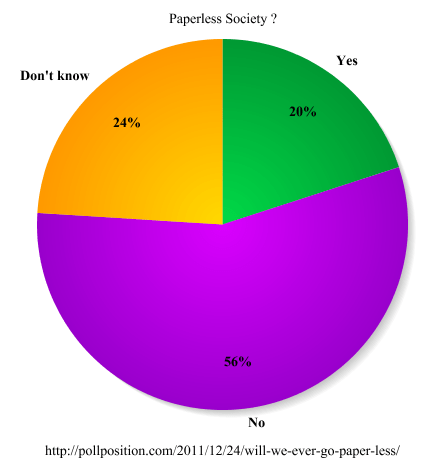
The trend will not change. A report from ITnewsLink reports that more than half of Americans think the U.S. will never go paperless. Pollster Poll Position conducted a national survey to see if Americans think the U.S. could ever be a paperless society.

Poll Position researchPoll Position’s research found that 56% of Americans said they don’t think the U.S. would ever be a paperless society. Only 20% said yes, one day we’ll all go paperless. 24% of Americans were undecided or had no opinion on the question.

Other Poll Position finding

  • 63% of the 18-29 age group said the U.S. would never be a paperless society and 23% said we could be a paperless society.
  • 56% of men and women said we could never be a paperless society.

You can still vote in their online companion poll.

rb-

I think that in an era of computers, Amazon (AMZN) Kindle Fire and Apple (AAPL) iPad tablet computers, iPhones and Google (GOOG) Android smartphones that paper consumption would decrease. Apparently it takes more than buzzwords like “paperless” and “green” to make a difference.

Related articles
  • The Paperless Office? (Going Green) (whattheythink.com)


Ralph Bach has been in IT long enough to know better and has blogged from his Bach Seat about IT, careers and anything else that catches his attention since 2005. You can follow him at LinkedInFacebook and Twitter. Email the Bach Seat here.