Tag Archive for Green

MSFT Powers Data Center with Sewers

MSFT Powers Data Center with SewersThe prize for the most unlikely clean power source may be going to Microsoft (MSFT). Greenbz.com reports that the boys from Redmond are working on powering data centers with sewage. Microsoft plans to power a demo data center with sewage, yeah poo.

Microsoft logoFuelCell Energy (FCEL) recently revealed to the blog, it is working with MSFT on a $5.5 million trial. The trial will use biogas from a wastewater treatment facility to power a fuel cell. The fuel cell at Dry Creek Water Reclamation Facility in Cheyenne, WY will provide “ultra-clean and carbon-neutral electricity” to a Microsoft data center.

InfoWeek says that biogas consists mostly of methane and carbon dioxide. It may also contain small amounts of other gasses, including hydrogen sulfide and nitrogen. The power is produced by anaerobic digestion. Anaerobic digestion is a process in which bacteria that live only in places without air break down organic, biodegradable matter.  Biodegradable matter is better known as sewage, animal manure, municipal waste, and plant material.

Fuel cell diagramThe initial trial will use one of FuelCell Energy’s sub-megawatt Direct FuelCell (DFC) power plant systems. The DFC will generate 200 kW of power for a Microsoft IT pre-assembled component (ITPAC) modular data center. The ITPAC is set up to resemble a standard data center environment. Any electricity not used by the data center will help power the water treatment plant. The system will also provide usable heat for the facility.

Direct FuelCell power plant systems

Power Engineering explains that stationary DFC power plants convert a fuel source into electricity and usable high-temperature heat suitable for making steam. DFC plants are fuel flexible, capable of operating on natural gas, renewable biogas, directed biogas, and other fuels including propane. The fuel cell generates electricity and heat electrochemically.

Gregg McKnight, general manager for data center advanced development at Microsoft, told Greenbiz.com that with the company has recently committed to becoming “carbon neutral” by 2013 it was committed to exploring the viability of a number of renewable energy sources. He is quoted in the article, “… Microsoft is researching new methods to help our operations become more efficient and environmentally sustainable,” he said.  “This project will study methods to provide an economical and reliable power supply for data centers that is also scalable and economical for use by other industries.”

rb-

OK let the snarky comments rip about MSFT software powered from the sewer or as one commenter noted, leave it to Microsoft to power its cloud services with a very different kind of cloud — a smellier, gaseous one.

I covered HP’s (HPQ) plans to power its data centers with cow manure here. It looks like Microsoft aims to build more data plants near other sources of renewable energy like landfills, wastewater treatment plants, and even dairy farms.

Related articles


Ralph Bach has been in IT long enough to know better and has blogged from his Bach Seat about IT, careers, and anything else that catches his attention since 2005. You can follow him on LinkedInFacebook, and Twitter. Email the Bach Seat here.

Microsoft Eliminating Backup Generators

MSFT Eliminating Backup GeneratorsThe venerable diesel backup generator has long been a symbol of reliability for mission-critical installations. Backup generators provide the emergency power required to keep servers online during utility power outages. Data Center Knowledge reports that the growing focus on using clean energy to power large data centers is prompting Microsoft (MSFT) and other tech titans to ditch their generators, along with their diesel fuel emissions.

backup energy options Microsoft is the latest company to announce its intention to cut its use of diesel generators. The move is part of a broader initiative to make Microsoft’s server farms more sustainable and less reliant on the utility grid according to DCK. Microsoft Utility Architect Brian Janous wrote in a recent blog post.

We are currently exploring alternative backup energy options that would allow us to provide emergency power without the need for diesel generators, which in some cases will mean transitioning to cleaner-burning natural gas and in other cases, eliminating the need for backup generation altogether.

Bloom Energy, fuel cellsDKC speculates that the reference to natural gas suggests that Microsoft is preparing to add fuel cells to replace its generators. That could be good news for Bloom Energy,  which recently scored wins to replace generators and UPS units at new data centers of eBay (EBAY) in Utah and supplement power Apple‘s (AAPL) data center in North Carolina.

DCK explains the Bloom Energy Server is a solid oxide fuel cell technology that converts fuel to electricity through an electrochemical reaction, without any combustion. The Bloom box can continue to run during grid outages because they are housed at the customer premises. Bloom boxes can run on natural gas or a range of other biofuels, including methane gas from landfills.

Diesel engine exhaust is a regulated pollutantAnother reason MSFT may be replacing generators according to DCK is that they have caused Redmond several headaches in recent years, including an Azure cloud outage in Europe (when multiple generators didn’t start during a utility outage) and public controversy about whether the diesel emissions from Microsoft’s generators in Quincy, WA could cause health problems for local residents. Diesel engine exhaust is a regulated pollutant and can be toxic in high concentrations.

Or Microsoft’s motivation could be to become less dependent on the utility grid and use renewable energy to power its servers the blog says. The company says its “data plants” will break new ground in integrating electricity and computing, bring together data centers and renewable power generation.

Biomass waste-powered data center.One type of renewable energy Microsoft has explored is a waste-powered data center. It could be built on the site of a water treatment plant or landfill. In his blog post, Janous indicated that Microsoft is evaluating a biomass project in Europe (rb- I wrote HP’s plan to use manure to run a data center here).

Given the unreliability of the electric grid and the need for continuous availability of cloud services, Microsoft maintains diesel generator backup at all of our data centers…” Janous wrote. “These generators are inefficient and costly to operate. From both an environmental and a cost standpoint, it makes no sense to run our generators more than we absolutely must.”

Microsoft data centerMicrosoft is also considering “long-term purchases from larger grid-connected installations that would displace some portion of our grid purchases,” Janous wrote. Google (GOOG) has embraced a similar strategy, using power purchasing agreements to add more than 200 megawatts of wind power to the local utility grids that support its data centers.

Microsoft is taking steps to position itself to make bulk power deals according to DCK. “We have recently signed on as an advisory board member with Altenex, an operator of a network that enables member companies to more efficiently engage with developers of renewable energy projects,” Janous said. “We expect this engagement with Altenex to improve our ability to identify and evaluate cost-effective clean energy projects.

rb-

Cummins logoI recall as a newbie techie the first time I had to be in on Sunday morning to work with the site engineer to crank up the 100 HP Cummins standby generator. The firm ran the monthly test to make sure the critical systems stayed up. The generator was enclosed in a secure room that contained the heat and noise. The exhaust was vented out. One of my regular jobs was to kick the standby 55-gallon drum of diesel with the hand pump on it to make sure there was fuel available for the generator.

Related articles


Ralph Bach has been in IT long enough to know better and has blogged from his Bach Seat about IT, careers, and anything else that catches his attention since 2005. You can follow him on LinkedInFacebook, and Twitter. Email the Bach Seat here.

Bill Ford Wants to Turn Michigan into “Silicon Valley of Mobility”

Bill Ford Wants to Turn Michigan into “Silicon Valley of Mobility” Ford Motor Company (F) Executive Chairman Bill Ford Jr. believes Detroit and Michigan can shed their rust belt persona. In a speech during the annual Mackinac Policy Conference, on Mackinaw Island, Mr. Ford said the Motor City can shed its rust-belt image and take on high-tech communities like San Francisco, Palo Alto, California, or Seattle. The Ford Chairman contends Michigan can be repositioned as the “Silicon Valley of Mobility.”

Ford logoThe Detroit Bureau observes this is a matter of been-there-done-that. In its heyday, in the early years of the 20th Century, Detroit was the quintessential American boomtown, much like Silicon Valley is today. It was dubbed by many the “Paris of the Midwest” because of its art, architecture, and sophisticated lifestyle. But things began to rapidly decline in the post-War years and today some old industrial sites are being converted back to farmland.

Chairman Ford insisted continuing decline is not inevitable, especially if Detroit and Michigan embrace new “green, smart technologies.” Mr. Ford continued, “To address this issue, we will once again need new technologies, as well as new ways of looking at the world. We will need to view the automobile as one element of a transportation ecosystem.

DetroitThe automobile, Bill Ford has noted on several occasions, can no longer be viewed as a standalone machine. Industry leaders need to accept and respond to such challenges as fuel economy, emissions, safety, and highway gridlock.

Bill Ford – Ford Motor Company Chairman

This technology is in varying stages of development and deployment, but it promises to radically transform the experience of driving,” said Ford during his speech. “As it develops, I believe Michigan must become the Silicon Valley of the mobility revolution.

The Ford Chairman noted the automaker has so far invested nearly a billion dollars in battery technology in Michigan. That includes upgrades to the Michigan Assembly Plant in the Detroit suburb of Wayne that recently began producing the new Ford Focus Electric. The factory will also add a plug-in hybrid version of Ford’s new C-Max “people-mover” later this year.

As TheDetroitBureau.com recently reported, there has been a significant turnaround in terms of high-tech job opportunities in Michigan. According to the Society of Automotive Engineers and other groups, there is now a shortage of trained specialists, especially with more advanced skills in areas such as fuel economy and emissions controls. And Detroit’s Big Three aren’t the only ones hiring. Virtually every major automaker and supplier now has a significant tech presence in Metro Detroit, including Toyota which has set up a major test track and engineering center near Ann Arbor.

In his speech, Chairman Ford noted a recent study by TechAmerica Foundation (which I also noted here) that found that despite the deep recession Michigan had added more high-tech jobs in 2009 and 2010 than any other state.

The turnaround of the Great Lakes State will require a significant effort, the Ford Chairman acknowledged and will take steps that make sure its competitiveness according to the article. He concluded his speech by calling on lawmakers to take several steps, including the elimination of personal property taxes and investment in upgrading the electrical grid – which many see as a significant impediment to both expanded industrialization and the growth of the electric vehicle market.

“We can keep this momentum going if we are frank about the areas in which we can improve and we build upon our advantages,” Ford added.

rb-

I think there are more fundamental problems that Michigan is going to have to solve before it can take on Silicon Valley. The labor supply pool in Michigan is very thin even for the most basic IT positions like field technicians. Where I am working now, it is a constant struggle to find staff that have some enterprise experience and people skills. I think that anybody with some good skills is either working or has left Michigan.


Related articles


Ralph Bach has been in IT long enough to know better and has blogged from his Bach Seat about IT, careers, and anything else that catches his attention since 2005. You can follow him on LinkedInFacebook, and Twitter. Email the Bach Seat here.

What Happened to the Paperless Office?

What Happened to the Paperless Society?The Economist wonders whatever happened to the “paperless office”? Thirty years ago computers were hailed as the beginning of the paperless office era. In 1980 The Economist recommended that firms trying to improve productivity “reduce the flow of paper, ultimately aiming to abolish it”.

Unfortunately not many people listened to The Economist. Since they extolled the virtue of a paperless office, global paper consumption has increased by half.

Paper consumption

The average American uses almost six 40-foot trees a year in paper. Gizmodo says don’t feel too bad. The EU bureaucracy in Brussels pushed the Belgian paper consumption to a whopping 8.5 trees per person. The equivalent to four Rockefeller Center Christmas trees.

Paperless office research says

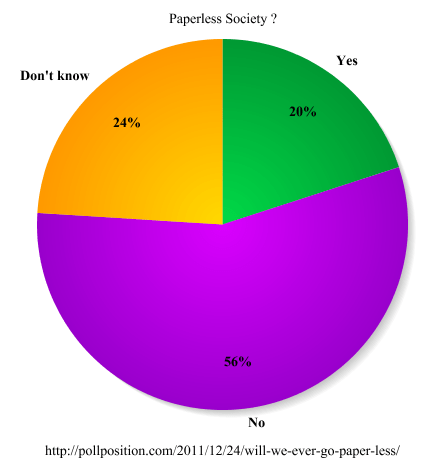
The trend will not change. A report from ITnewsLink reports that more than half of Americans think the U.S. will never go paperless. Pollster Poll Position conducted a national survey to see if Americans think the U.S. could ever be a paperless society.

Poll Position researchPoll Position’s research found that 56% of Americans said they don’t think the U.S. would ever be a paperless society. Only 20% said yes, one day we’ll all go paperless. 24% of Americans were undecided or had no opinion on the question.

Other Poll Position finding

  • 63% of the 18-29 age group said the U.S. would never be a paperless society and 23% said we could be a paperless society.
  • 56% of men and women said we could never be a paperless society.

You can still vote in their online companion poll.

rb-

I think that in an era of computers, Amazon (AMZN) Kindle Fire and Apple (AAPL) iPad tablet computers, iPhones and Google (GOOG) Android smartphones that paper consumption would decrease. Apparently it takes more than buzzwords like “paperless” and “green” to make a difference.

Related articles
  • The Paperless Office? (Going Green) (whattheythink.com)


Ralph Bach has been in IT long enough to know better and has blogged from his Bach Seat about IT, careers and anything else that catches his attention since 2005. You can follow him at LinkedInFacebook and Twitter. Email the Bach Seat here.

GM Saves Energy Through Smart IT

Andrew Winston at the Harvard Business Review writes that opportunities for improving energy efficiency and saving real money are everywhere. The proverbial low-hanging fruit are actually, in the words of energy guru Amory Lovins, fruit on the ground. GM (GM) recently announced a new way to find easy pickings, a shockingly straightforward change in how it runs its manufacturing plants. The Detroit-based auto giant is saving $3 million annually in energy costs across 10 plants by shutting down equipment when it’s not needed.

General MotorsMr. Winston says the man in charge of the program is Mike Durak, the Global Program Manager, IT. According to the article, GM is using General Electric (GE) Proficy Software to automate the shutdown and restart of its equipment. It started simply enough, GM set the lighting in one plant to synch up with the conveyor. When the manufacturing line stopped, for breaks or between shifts, the lighting would shut off. Seeing the quick payback, the managers added all energy-using systems to this automated network, from heating and cooling systems to pumps and compressed air units. The investment in connecting an entire plant is paying back through energy savings alone in just 6 months.

HBR says that previously GM shutdowns equipment multiple times a day with a combination of manual shutdowns and unconnected, or “dumb”, automation. Basically, energy use would gradually ramp down after production stopped as equipment was shut off, and then it would ramp back up before the next shift. “Energy use was in a ‘V-shape’,” Mr. Durak said, “and now it’s more like a U.” (The author says, the difference between a V-shape and a U-shape is what’s saved).

EnergyMr. Winston calls these sudden wins “headslappers” because they’re so obvious…in retrospect. The reasons we miss these easy wins are varied — from inertia to not being incentivized to find them to the classic problem of always addressing what’s urgent (something broken or a new process) over what’s important (getting leaner). Or perhaps a simple, cheap technological fix was not available until recently. In GM’s case, the big change is economically networking a whole range of equipment that wasn’t connected before. So with the new systems in place, managers can use the GE software to monitor and control the plant to a much finer degree.

rb-

Maybe GM is getting smarter; they are figuring out what a “smarter” factory looks like. the Chevy Volt seems to be a “smarter” car.

What do you think?

What is your organization doing to get smarter?

Related articles:


Ralph Bach has been in IT long enough to know better and has blogged from his Bach Seat about IT, careers, and anything else that catches his attention since 2005. You can follow him on LinkedInFacebook, and Twitter. Email the Bach Seat here.