
Tag Archive for IBM

Brocade Selling Itself

Brocade Selling ItselfChannelInsider citing the Wall Street Journal is reporting that network equipment maker Brocade Communications Systems Inc. put itself up for sale on 10-05-09. The paper, citing people familiar with the matter, said Oracle and Hewlett-Packard were potential bidders for the company, but a deal was not imminent and Brocade may not even go ahead with a sale. Oracle CEO Larry Ellison told investors at Oracle’s annual shareholder conference Wednesday. “We have no interest in buying Brocade,” in response to a question from an investor according to Fortune.

Data centerTo compete with much bigger rival Cisco Systems Inc, the company has been bolstering sales partnerships with large technology vendors such as IBM and Dell to expand their customer reach. In an interview with Reuters last month, Brocade Chief Executive Michael Klayko had said he did not see a need for Brocade to merge with or acquire another company, citing the company’s expertise and partnerships.

However, Goldman Sachs analyst Min Park told Fortune, interest in Brocade is picking up, “Brocade is a likely strategic fit for a number of potential acquirers.” He includes Hewlett Packard, Juniper, Dell, IBM, and Oracle among those interested in Brocade.

rb-

It is unlikely that Dell will purchase Brocade since Dell has Perot Systems to digest and a sales partnership with Brocade. Juniper is not in the financial position but is the most need of the product. IBM is financially capable but the hardware business seems to be losing focus at Big Blue. That leaves HP  for three reasons, first, it is financially capable, second, it is looking to grow its ProCurve business and its EDS acquisition is well underway. The wild card could be Huawei if they can get government approval. Of course, Brocade CEO Mike Klayko just may have needed some extra pocket money as the Wall Street Journal article triggering a 14 percent jump in the company’s shares. Mr. Klayko’s $5 million in options increased by $700,000 in one day.


Ralph Bach has been in IT long enough to know better and has blogged from his Bach Seat about IT, careers, and anything else that catches his attention since 2005. You can follow him on LinkedInFacebook, and Twitter. Email the Bach Seat here.

Smart Grid needs IPv6

Smart Grid needs IPv6Cisco Systems is looking at IPv6 as a critical component in securing the next-generation electricity distribution system. IPv6 is attractive to the Smart Grid initiative for two reasons, the first being an abundance of IP addresses available in the expanded 128-bit address space for all the gizmos they hope to sell in a market that Cisco pegs at $20 billion a year. “IPv6 is an interesting discussion and one that occupies a lot of bandwidth at Cisco,” Marie Hattar, Cisco’s vice president of network systems and security solutions marketing, told InternetNews.com. “Some people say that for smaller deployments, we could get away with IPv4, but the smart grid has a number of parts.

The second benefit to the Smart Grid is the security features in IPv6 which will add a layer of protection to the vulnerable electric grid management systems. Security is also now top of mind as the Department of Homeland Security (DHS) is now investigating a report into potential threats to the West Coast power grid. Earlier this year, widely circulated reports noted that foreign entities—presumably from China—infiltrated the U.S. power grid on several occasions and have the ability to disrupt power distribution.

China infiltrated the U.S. power grid

At the 2009 Black Hat security conference, a security researcher detailed security vulnerabilities in smart grid meters. “If you think about hacking into a smart meter, it’s like hacking into your TV’s remote control — you still get your TV,” Ms. Hattar said. “The meters are a reporting mechanism but it’s not going to affect the electrical system.” Still, Cisco’s Hattar added that smart meter vendors are concerned about security and Cisco will work with them. “A key part is to build out an end-to-end framework that is secure. A lot has to do with isolation and not exposing the grid to points of entry that are hackable.

As utilities are looking to build out smart grid, it’s more effective to agree on a common protocol across the board as opposed to trying intermix different ones,”  Hatter says. “In many ways, this is like the early days of the Internet where we ultimately settled on IP. We see IP as the scalable protocol for smart grid and we’re working with a variety of vendors to advocate this and make this the key protocol of choice.

Cisco is among the numerous IT vendors with initiatives for improving the power grid. IBM is working with several of its partners on power grid issues through its Smart Planet program.

There’s likely to be subsidiary benefits to the smart grid, like furthering the cause of IPv6  since tens of millions of users and new devices around the world will require connectivity. For example, with utilities adopting IP-enabled metering for thousands of homes connected to the network, there could be an issue with addressing over IPv4. On IPv6, thanks to its plentiful address availability, there are no addressing issues.

rb-

Not only is this a technological issue, but it is an energy policy issue. An electrical grid that can support Smart meters, will allow energy producers to better control the flow of electricity, which will increase the efficiency of the electrical grid, which will, in turn, decrease our dependence on fossil fuels. America needs to get off of electrical generation by fossil fuels and this technology can speed the process before it is too late and gasoline reaches $7.00 a gallon making the current recession seem like a walk in the park.


Ralph Bach has been in IT long enough to know better and has blogged from his Bach Seat about IT, careers, and anything else that catches his attention since 2005. You can follow him on LinkedInFacebook, and Twitter. Email the Bach Seat here.

Big Blue Props Up Broadband over Powerline

Big Blue Props Up Broadband over PowerlineBig Blue continues to support Broadband over Powerline (BPL) as a way to close the broadband divide in rural areas. According to an IBM Global Financing press release the division has established a financing agreement with DS2, a supplier of integrated chip technology for powerline vendor International Broadband Electric Communications’ Broadband over Powerline Regenerating Unit (BRU) smart boxes. The BRU’s are attached to an electric utility pole to provide high-speed Internet signals to residential customers via the electrical drop. IBEC is working with rural electric utility cooperatives to extend broadband access to ‘unserved’ customers mainly in the South, East, and Midwest.

This is not Big Blue’s first major BPL investment. Even as many industry pundits were reading BPL its last rites, IBEC signed a $9.6 million agreement with IBM to deploy BPL networks in Eastern U.S. electric cooperatives. The investment was heralded by the Utilities Telecom Commission (UTC) as a “major step forward in bringing broadband services to the residents of rural America.” At that time, IBM and IBEC said they were working with the Midwest Energy Cooperative to deliver broadband over powerline to area residents and businesses throughout the seven counties the utility serves.

rb-

Sounds to me like they are propping up their SmartGrid ecosystem in the upcoming battle with Cisco over the estimated $20 Billion a year electrical grid modernization market.


Ralph Bach has been in IT long enough to know better and has blogged from his Bach Seat about IT, careers, and anything else that catches his attention since 2005. You can follow him on LinkedInFacebook, and Twitter. Email the Bach Seat here.

Global Tech Layoffs Pass Half a Million

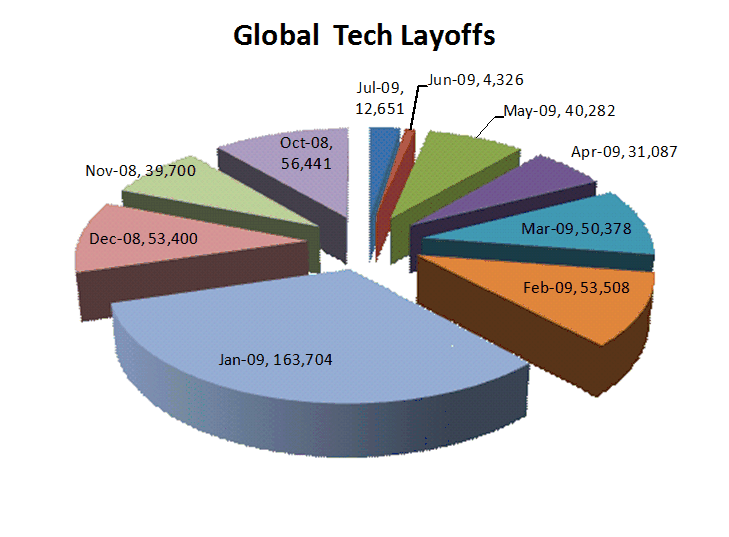
The global body count in the tech sector has risen above 500,000 in July 2009. Since the correction, recession, economic melt-down started in earnest in October 2008, about 505,477 tech-related jobs have been right-sized, down-sized, resource actions eliminated. January 2009 is the worst month for employees with nearly 164,000 tech jobs eliminated. October 2008 saw over 56,000 workers pink-slipped. Approximately 53,500 tech workers we laid off in both December 2008 and February 2009. The last two months have shown a decline in the numbers of tech workers getting the ax. In June 2009, 4,326 workers were laid off, the smallest monthly count since the economic meltdown started. July 2009 witnessed 12,65 layoffs, most from Verizon. The July count is also well below the average 50,000 lay-offs a month pace being set during the economic meltdown.Global Tech Layoffs
rb-

These numbers say to me that we are still in for a long hard year before anything like a real turn-around emerges. So despite what Newsweek says, the recession is not over.

Among the firms that generated these layoffs are:


Ralph Bach has been in IT long enough to know better and has blogged from his Bach Seat about IT, careers, and anything else that catches his attention since 2005. You can follow him on LinkedInFacebook, and Twitter. Email the Bach Seat here.

Server Sales Slide

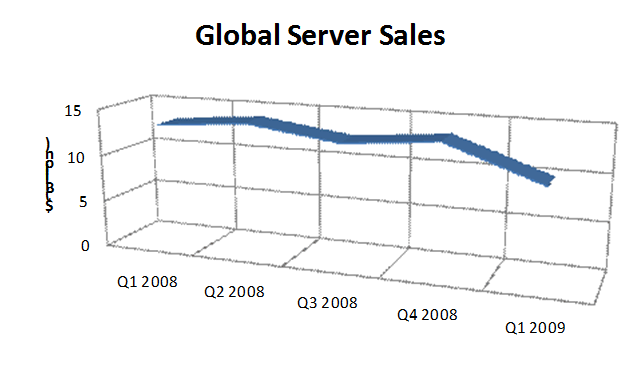
Server Sales SlideLike most of us (except the bankers) global sales of servers have taken a beating since the first quarter of 2008. Server sales have declined by over $3 billion due to the economic slowdown meltdown recession and the growth of virtualization. Today, the global server market stands below $10 billion.
Global Server Sales

IBM logoSince Q1 of 2008 IBM‘s server revenues have declined over $1 billion from $3.946 billion to $2.913 in Q1 2009. Big Blues’ market share also declined from 30% to 29.3% during the same period. On the other hand, HP (HPQ) revenues grew from $2.904 billion to $3.624 billion and grew their market share to 29.3%, matching IBM in Q1 2009. Dell’s (DELL) revenues dropped from  $1.590 billion in 2008 Q1  with a 12.1% market share to revenues of $1.093 billion and an 11% market share in Q1 2009.

HP logoAccording to the ChannelInsider article:

  • No quick recovery for server sales until the general economy recovers (CI)
  • End-users continue to extend the life of existing servers (CI, other sources)
  • Servers remain among the least profitable for solution providers (CI: Market Pulse)
  • Demand for conventional and blade servers by end-users continues to shrink (CI: Market Pulse)
  • The popularity of data center virtualization technologies have had the collateral effect of shrinking server hardware demand (CI)

Ralph Bach has been in IT long enough to know better and has blogged from his Bach Seat about IT, careers, and anything else that catches his attention since 2005. You can follow him on LinkedInFacebook, and Twitter. Email the Bach Seat here.