
Tag Archive for INTC

Hourglass Syndrome

Hourglass SyndromeA July 2010 technology online study conducted by Harris Interactive (NASDAQ: HPOL) and sponsored by Intel Corporation (NASDAQ: INTC), reveals that eight out of 10 (80%) U.S. adults get frustrated waiting for technology, and over half (51%) have done something out of character when frustrated while waiting for technology. Intel calls this the “Hourglass Syndrome.

Intel logoIntel says that of those who suffer from the hourglass syndrome:

  • 69% admitted acting inappropriately while waiting.
  • 62% of U.S. adults admit to yelling or cursing out loud when their technology can’t keep up with them.
  • 29% hit their computer mouse.
  • 24%  bang on their computer screen and keyboard, hopefully not to the extent as the guy in the video.

The integral role technology plays in everyday life causes the hourglass syndrome phenomenon says the chipmaker. Intel marketing experts say the “malady” has developed with the modern pace of life. In an environment where mobile devices are constantly on to answer emails within minutes of receiving them, people feel anger and frustration when outdated technology fails to keep up with the speed of life.

Margaret (Margie) Morris, a clinical psychologist and health technology researcher at Intel, states in the Intel press release;”We are closely connected with our devices  … They become extensions of ourselves and become critically involved in our relationships with others, how we express ourselves, and our efforts to manage stress. We enjoy the freedom to communicate and work from anywhere, so we rely on the technology to work. When it lets us down, the disappointment runs high and sometimes spills over into our feelings about ourselves.

Of those who have acted or seen someone act inappropriately in public due to frustrations with technology:

  • 70% saw strangers.
  • 46% have seen family or friends.
  • 33% have seen co-workers act out in frustration while waiting for technology.

According to the online survey taken between July 27-29, 2010 sluggish technology often causes people to miss out on something while they are waiting. 35% of U.S. adults said that they missed out on something while waiting for technology, such as losing an opportunity to take part in an online sale (13%) or buy airline, concert, or sporting event tickets. “Intel understands how stressful technology can be,” said Karen Regis, Director of Intel’s Consumer PC Marketing in the press release. “We are determined to design products that can improve the quality of your life and lower your stress levels, as opposed to increasing them.

rb-

Kudos to Intel for the imaginative use of pseudo-science to wrap a marketing message for Intel Turbo Boost Technology in a factoid.  GigaOm points out that Intel, “helpfully notes that Hourglass Syndrome “is not a real syndrome or medical condition.”


Ralph Bach has been in IT long enough to know better and has blogged from his Bach Seat about IT, careers, and anything else that catches his attention since 2005. You can follow him on LinkedInFacebook, and Twitter. Email the Bach Seat here.

Intel Shows TBps Connections

Intel Shows TBps ConnectionsThe EETimes reports that researchers at Intel Corp. (INTC) have demonstrated optical chips can transmit up to terabit-per-second of data transmission. The new silicon photonic chips will replace copper connections in everything from supercomputers to servers to PCs chips predicts Intel. The new chips can currently transmit data at 50 Gigabits per second (Gbps). 50 Gbps equates to transferring an HD movie a second.

This milestone marks the beginning of silicon photonics in the high-volume marketplace, in applications from [high-performance computing] all the way down to the client PC,” said Mario Paniccia, director of Intel’s Photonics Technology Lab. “We see a clear development path from 50 Gbps today to a terabit in the future,” Mr. Paniccia told EETimes.

Intel says that optical connections could eventually replace the copper connections between systems and even between boards in the same system and down to cores on the same board. intel’s Paniccia estimated that the first commercial applications of silicon photonics will begin appearing in as little as five years in data centers and supercomputer facilities.

The modulators required to encode optical information using signal waveguides and photodiodes are cast in silicon on custom chips designed by Intel. The transmitter chip uses Intel’s hybrid silicon laser technology that bonds a small indium phosphide die to on-chip silicon waveguides, four of which are patterned into a connected optical laser.  “We combined our silicon manufacturing techniques with our hybrid laser and demonstrated an integrated transmitter using four lasers each operating at a different wavelengths and four silicon modulators each operating at 12.5 Gbps, then combined them together into an aggregate 50 Gbps into the optical fiber,” said Paniccia.

The optical fiber output on the receiver chip is then filtered into separate colors and diverted by waveguides into four separate photodiodes, each of which receives one of the four separate 12.5-Gbps channels. In the future, Intel plans to add more lasers per chip and increase the number of channels. Intel believes that it can put 25 lasers on a single chip to produce the 1 Tbps capabilities. It then hopes to commercialize the optical connection technology.  Intel has been developing the technology since 2004.

Intel already has a 10-Gbps Light Peak chip that uses conventional optical technologies that are aimed at reducing the number of port connections on a computer. The Silicon Photonics Link is different from Light Peak technology. Intel’s Light Peak technology – an optical cable that is aimed at reducing the number of port connections on a computer. said it used traditional optical devices and scaling it beyond 10 Gbps speeds would be difficult.

rb-

For some perspective, the 1 terabit per second link could transfer the entire printed collection of the Library of Congress in 1.5 minutes.

Intel is preaching high bandwidth and low cost with these chips. If Intel can deliver, it could change the nature of system design. Theoretically, these chips could allow system components to the spaced further apart without the performance hit. With these chips, data center expansion could be down the hall instead of a full re-design. Now it may be cheaper to take the new gear to the available electrical panel rather than adding a new panel to the server room.

Intel’s Paniccia told VentureBeat that the accuracy of the data transfer is superb. So far, it has been proven to be able to transfer data with no errors for 27 hours straight, which means it can transfer more than a petabyte of data without an error.


Ralph Bach has been in IT long enough to know better and has blogged from his Bach Seat about IT, careers, and anything else that catches his attention since 2005. You can follow him on LinkedInFacebook, and Twitter. Email the Bach Seat here.

Tech Layoffs

Tech LayoffsIt has been just over a year since Wall $treet and the Bankers lead the global economy to the edge of collapse. Thanks to Obama-money our money Wall $treet and the Bankers are making million-dollar bonus’ again while worker layoffs continue. All must be right in the economy, right?
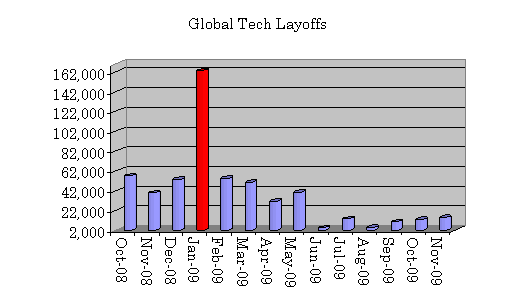
According to my information, nearly 550,000 tech-related jobs have been eliminated since October 2008. January 2009 saw almost 164,000 jobs eliminated by the biggest names in tech. Ericsson. Google, IBM, Intel, Microsoft, NEC, and Sprint-Nextel all eliminated 5,000 or more jobs in January 2009. While this is old news, unless you are still trying to live through one of these “right-sizing” it is also important because we are coming back around to the lay-off season.

Global Tech Layoffs

This year’s lay-off season is trending up after several months of decline. From a record high in January tech layoffs declined to a modest 4,336 layoffs in June 2009. Since reaching that bottom the tech layoff rate has increased to levels not seen since May 2009. August 2009 had almost 5,000 layoffs. The number of layoffs in September doubled to 10,246. The trend has been increasing since with 12,704 layoffs in October and in the first half of November, there have been already been 12,749 layoffs. Some of the same firms that had “resource reduction actions” in January had laid off more people in November, including Ericsson (700), Microsoft (800), and Sprint-Nextel (2,500).

Tech Layoffs Last Quater 2009

It appears to me that despite Wall $treet bonus’. the rest of us are still in for at least 12 more months of questionable job prospects


Ralph Bach has been in IT long enough to know better and has blogged from his Bach Seat about IT, careers, and anything else that catches his attention since 2005. You can follow him on LinkedInFacebook, and Twitter. Email the Bach Seat here.

Nokia Tries Wireless Electricity

Nokia Tries Wireless ElectricityIf someday the researchers at Nokia (NOK), are right you will be able to use wireless electricity to charge your mobile. Putting your cell phone in standby mode may no longer cause the dreaded vampire power. Vampire power is often described as pointlessly wasting electricity with little benefit other than a small red light and instant start-up.

Nokia logoAccording to an article in the UK’s Guardian, Nokia is developing a mobile phone charging system that is able to power itself on nothing more than ambient radiowaves that constantly surround us. The Guardian article points out that radiowaves power the old crystal radio sets and modern radio frequency identification (RFID) tags.

Nokia claims that its system is able to scavenge enough ambient electromagnetic radiation emitted from Wi-Fi transmitters, cell-phone antennas, TV towers, and other sources miles away to run a cell phone. Individually the energy available in each of these signals is minute, but by harvesting radio waves across a range of frequencies it all adds up, said Markku Rouvala, one of the researchers who developed the device at the Nokia Research Center in Cambridge, UK.

Nokia’s device uses a wide-band antenna and two very simple passive circuits. The design of the antenna and the receiver circuit makes it possible to pick up frequencies from 500 megahertz to 10 gigahertz and convert the electromagnetic waves into an electrical current. The second circuit is designed to feed this current to the battery to recharge it.

Even if you are only getting microwatts (mW), you can still harvest energy, provided your circuit is not using more power than it’s receiving,” Rouvala told Technology Review. So far the researchers have been able to harvest up to 5 mW. Their next goal is to get in excess of 20 mW, enough power to keep a phone in standby mode indefinitely. but not enough to actually use the phone to make or receive a call the researcher says.  Rouvala says that his group is working towards a prototype that could harvest up to 50 mW of power, enough to slowly recharge a switched-off phone.

Earlier this year, Joshua Smith at Intel and Alanson Sample at the University of Washington, in Seattle, developed a temperature-and-humidity sensor that draws its power from the signal emitted by a 1.0-megawatt TV antenna 4.1 kilometers away. This only involved generating 60 mW.  Smith says that 50 mW could need around 1,000 strong signals and that an antenna capable of picking up such a range of frequencies would cause efficiency losses along the way.

Harry Ostaffe, head of marketing for Pittsburgh-based company Powercast, which sells a system for recharging sensors from about 15 meters away with a dedicated radio signal told Technology Review, “To get 50 milliwatts seems like a lot.

If Nokia’s claims stand up, then it could push energy harvesting into mainstream consumer devices and improve their environmental footprint. Steve Beeby, an engineer and physicist at the University of Southampton, U.K., who has researched harvesting vibrational energy, adds, “If they can get 50 milliwatts out of ambient RF, that would put me out of business.” He says that the potential could be huge because MP3 players typically use only about 100 milliwatts of power and spend most of their time in lower-power mode.

According to Technology Review. Nokia is being cagey with the details of the project, but Rouvala is confident about its future: “I would say it is possible to put this into a product within three to four years.” Ultimately, though, he says that Nokia plans to use the technology in conjunction with other energy-harvesting approaches, such as solar cells embedded into the outer casing of the handset.

rb-

As I have chronicled in the past and here, wireless power is a good solution looking for a way to be implemented. Wireless power has now hit the GartnerHype-Cycle.” According to the July 2009 Gartner Hype-Cycle, Wireless Power has just entered the “Peak of Inflated Expectations” zone and is still 5-10 years from mainstream adoption. 

This technology holds many benefits to the environment (less wasted electricity) and user convenience (how many proprietary power adapters do you have?), it is yet to be seen if consumer demand can overcome the inertia of the status quo and the power of big money lobbying by the coal, nuclear and utilities. Right now my money is on the money.


Ralph Bach has been in IT long enough to know better and has blogged from his Bach Seat about IT, careers, and anything else that catches his attention since 2005. You can follow him on LinkedInFacebook, and Twitter. Email the Bach Seat here.

Wireless Electricity Gets Closer

IntelWireless Electricity Gets Closer (INTC) has been working on wireless electricity technology for several years, which I wrote about earlier, that now works over longer distances. At its Intel Research Day at the Computer History Museum in Mt. View CA, on 06-18-2009, the company showed off a new variation of the idea that power can be transmitted through the air to run a speaker without any other power source.

wireless electricityIntel now calls the technology Wireless Resonant Energy Link (WREL). Intel’s goal of the WREL project is to cut the power cord. Building on principles proposed by MIT physicists in 2006. The WREL team has lit a 60W light bulb at a range of several feet and with 70% efficiency.

WREL works in a fashion similar to the old 1970’s Memorex commercial staring Ella Fitzgerald where a singer can shatter a glass by hitting its natural frequency, at which it absorbs energy efficiently. In the case of WREL, a coil of wire with a natural frequency around 10MHz takes the place of the glass, and a similar coil takes the place of the singer.

The technology uses two flat copper coils tuned to resonate at a particular frequency. One wire releases electromagnetic energy and the other picks it up in much the same way an opera singer can shatter a wine glass by singing at just the right pitch, said researcher Emily Cooper. The wireless electricity transmission shows the efficiency of 90 percent at distances of up to a meter, she said.

Intel hopes the technology will be useful for charging devices like netbooks or smartphones in a room without wires. Intel also predicts the technology could be used within devices such as a laptop.  to replace the fallible wires that connect laptop screens through a hinge, Cooper said

rb-

Intel logoIntel admits that the next milestone for the WREL project is to build a rectifying circuit that can convert the RF power to DC power without upsetting the carefully tuned pair of coils. Intel has demonstrated they can charge a light bulb with 60W of wireless electricity which should be sufficient to charge a laptop.

However to power a laptop or charge a battery, Intel will need DC power, not a 10MHz AC signal. The need to drive down the power requirements for the next generation of computing devices is also helping drive Intel’s latest attempt to break into the UMPC process market with the Atom chips and the next-generation “Moorestown” processor which boasts lower energy consumption requirements. It is also notable that Intel has a stated long-term plan of 60watts power for mainstream desktop processors, down from a maximum consumption of 130 watts of the new Pentium Extreme Edition 840, according to Benson Inkley, a senior processor applications engineer, with Intel in an article at Tom’s Hardware.

While it seems that Intel is on a trajectory to cut the power requirements and costs of owning and operating a PC fleet, it will be a while. It is much more likely that Moorestown processors are going to be aided by the pending IEEE 802.3at POE+ specification which will allow up to at least 30W which can be used to charge devices. It is my guess that the reports of the demise of wired networking are greatly exaggerated until Intel figures out how to economically and safely deliver 60W through the vapor.

Related articles


Ralph Bach has been in IT long enough to know better and has blogged from his Bach Seat about IT, careers, and anything else that catches his attention since 2005. You can follow him on LinkedInFacebook, and Twitter. Email the Bach Seat here.