 IBM scientists will report on a prototype optical chipset, dubbed “Holey Optochip.” It is the first parallel optical transceiver to transfer one trillion bits – one terabit – of information per second. IBM will present the new chip at the 2012 Optical Fiber Communication Conference, conference for optical communications and networking professionals.
 The Holey Optochip is a standard silicon CMOS chip with holes punched in it. According to ITnewsLink, it was not possible to transport terabits of data for existing parallel optical communications technology until now. Reportedly the new IBM (IBM) chip prototype will deliver ultra-high interconnect bandwidth. The new compact chip will efficiently enable bandwidth to facilitate growth. Some of the segments it is targeted at are big data and cloud computing and next-generation data center applications.
Big Blue speculates that the chip could move information eight times faster than today’s systems. Speeds that fast could transform how data is accessed, shared, and used. It could open a new era of communications, computing, and entertainment. “Reaching the one trillion bit per second mark with the Holey Optochip marks IBM’s latest milestone to develop chip-scale transceivers that can handle the volume of traffic in the era of big data,” said IBM Researcher Clint Schow, part of the team that built the prototype.
 The holes in Holey Optochip allow light through the chip. They produce an ultra-compact, high-performing, and power-efficient optical module. It is capable of record-setting data transfer rates. ITnewsLink says optical networking can significantly improve data transfer rates by speeding the flow of data using light pulses, instead of sending electrons over wires. Researchers have searched for ways to make use of optical signals widespread within standard low-cost, high-volume chip manufacturing. The Holey Optochip module is constructed with commercially available components, providing the possibility to manufacture at economies of scale.
“We have been actively pursuing higher levels of integration, power efficiency, and performance for all the optical components through packaging and circuit innovations. We aim to improve on the technology for commercialization in the next decade with the collaboration of manufacturing partners,” Mr. Schow said in a press release.
 The Holey Optochip is green
The Holey Optochip achieves its speed while consuming less than five watts. IBM claims the power consumed by a 100W light bulb could power 20 transceivers. This progress in power-efficient interconnects will allow companies who adopt high-performance computing to manage their energy load while performing powerful applications such as analytics, data modeling, and forecasting.
Technical Aspects of the Holey Optochip
The article explains that parallel optics is a fiber optic technology. It is primarily targeted at high-data, short-reach multimode fiber systems that are typically less than 150 meters. Parallel optics differ from traditional duplex fiber optic serial communication. In parallel optics, data is simultaneously transmitted and received over multiple optical fibers.
 A single 90-nanometer IBM CMOS transceiver IC becomes a Holey Optochip with the fabrication of forty-eight through-silicon holes, or “optical vias.” There is one optical via for each transmitter and receiver channel. Simple post-processing on completed CMOS wafers with all devices and standard wiring levels results in an entire wafer populated with Holey Optochips. The transceiver chip measures only 5.2 mm x 5.8 mm. Twenty-four channel, industry-standard 850-nm VCSEL (vertical cavity surface emitting laser) and photodiode arrays are directly flip-chip soldered to the Optochip. This direct packaging produces high-performance, chip-scale optical engines. The Holey Optochips are designed for direct coupling to a standard 48-channel multi-mode fiber array through an efficient microlens optical system that can be assembled with conventional high-volume packaging tools.
rb-
This one does not count as a new speed record – yet. It’s not real. Once Big Blue demonstrates Holey Optochip in the real world like this and this then it probably will be the fastest toy in town. The raw speed of one transceiver is equal to the bandwidth consumed by 100,000 users at today’s typical 10 Mb/s high-speed internet access.
At one terabit per second, IBM’s Holey Optochip will offer unprecedented amounts of bandwidth to move data like machine-to-machine communications (M2M) and other Internet of Things (IoT) components as well as posts to social media sites like Facebook (FB) and Twitter, videos to YouTube and digital pictures to Pinterest.
 But wait what if we use WDM within the light going thru Optochip.
Or better yet QAM 16 or even QAM 64
Or even more betterer QAM 256 running inside each wavelength of WDM.
Ralph Bach has been in IT long enough to know better and has blogged from his Bach Seat about IT, careers, and anything else that catches his attention since 2005. You can follow him on LinkedIn, Facebook, and Twitter. Email the Bach Seat here.


 The venerable Video Graphics Array (VGA) port and it upstart cousin digital-visual interface (DVI) port will become extinct over the next five years. So says Brian O’Rourke, research director at NPD In-Stat in a recent report published on PCWorld. NPD In-Stat points out how new laptops today come with HDMI and DisplayPort for interfacing with HDTVs, monitors and projectors.
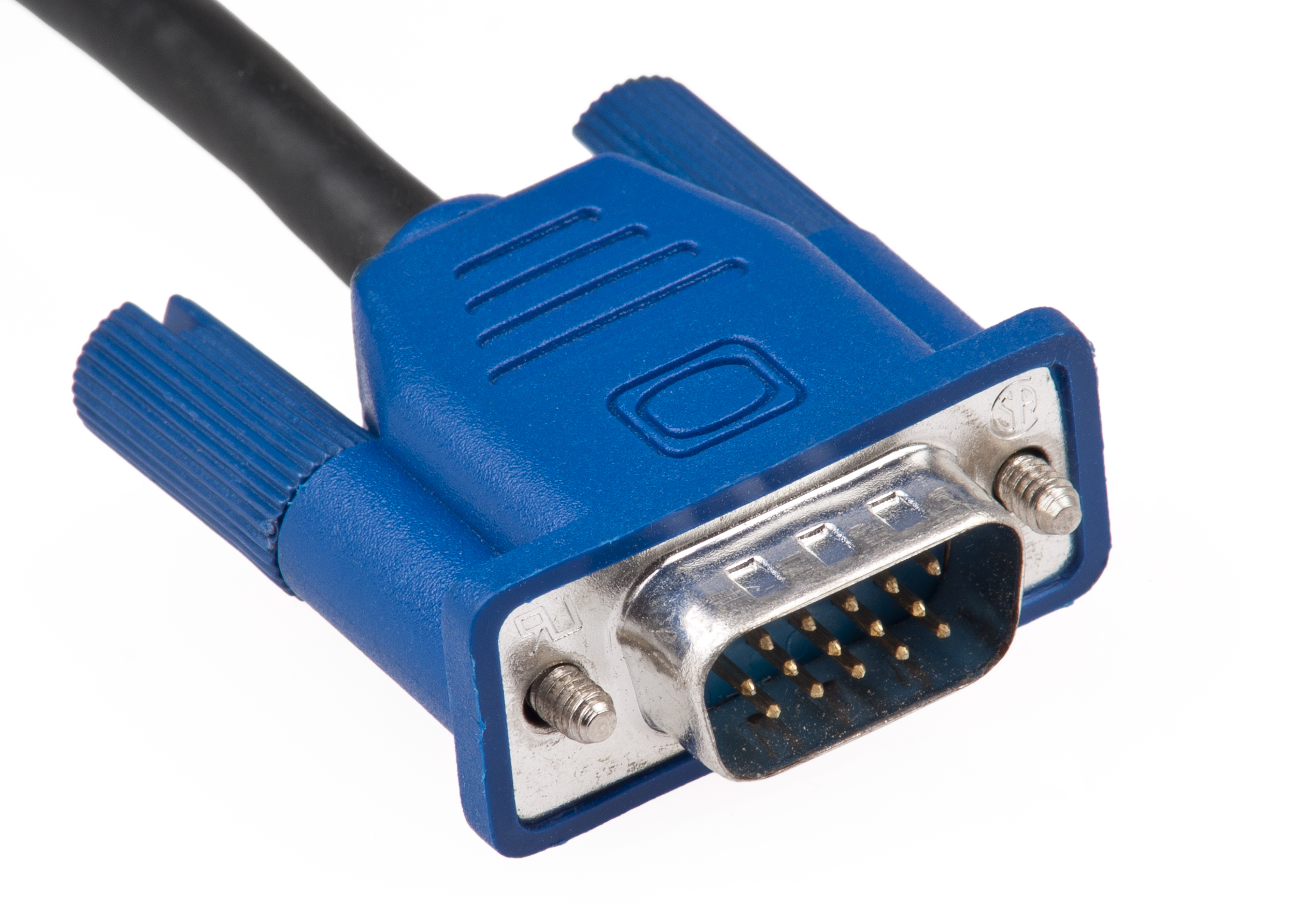 has no upgrade path, and DVI has only gone through one minor upgrade cycle; in comparison, HDMI and DisplayPort are continuously being upgraded, according to O’Rourke. More importantly, chipmakers such Intel (INTC) and AMD (AMD) are phrasing out chipset support for VGA by 2015, while AMD has announced it will phase out chipset support for DVI by 2015. NPD In-Stat is forecasting shipments of devices with DVI, HDMI, and DisplayPort to pass 2 billion by 2015.
 Of course, its forced retirement will mean that VGA will no longer be available as a fallback option for auditoriums and function rooms around the world. The presence of interface adapters can help, though businesses will probably need to give greater consideration to the presence of multiple interface support when acquiring new display devices or projectors.


 Summer is finally here again. It is going to be 90 out this weekend and I have to get the lawn cut. It is time to seriously consider putting tech to work for me. The
