Tag Archive for Amazon

What Happened to the Paperless Office?

What Happened to the Paperless Society?The Economist wonders whatever happened to the “paperless office”? Thirty years ago computers were hailed as the beginning of the paperless office era. In 1980 The Economist recommended that firms trying to improve productivity “reduce the flow of paper, ultimately aiming to abolish it”.

Unfortunately not many people listened to The Economist. Since they extolled the virtue of a paperless office, global paper consumption has increased by half.

Paper consumption

The average American uses almost six 40-foot trees a year in paper. Gizmodo says don’t feel too bad. The EU bureaucracy in Brussels pushed the Belgian paper consumption to a whopping 8.5 trees per person. The equivalent to four Rockefeller Center Christmas trees.

Paperless office research says

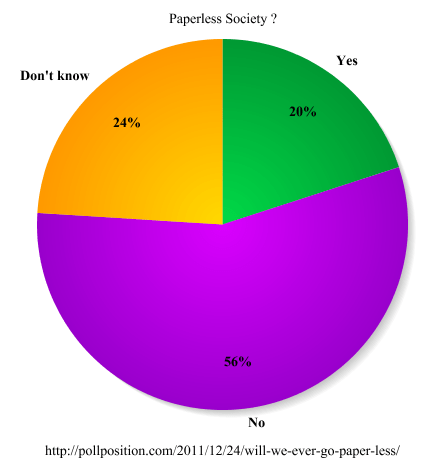
The trend will not change. A report from ITnewsLink reports that more than half of Americans think the U.S. will never go paperless. Pollster Poll Position conducted a national survey to see if Americans think the U.S. could ever be a paperless society.

Poll Position researchPoll Position’s research found that 56% of Americans said they don’t think the U.S. would ever be a paperless society. Only 20% said yes, one day we’ll all go paperless. 24% of Americans were undecided or had no opinion on the question.

Other Poll Position finding

  • 63% of the 18-29 age group said the U.S. would never be a paperless society and 23% said we could be a paperless society.
  • 56% of men and women said we could never be a paperless society.

You can still vote in their online companion poll.

rb-

I think that in an era of computers, Amazon (AMZN) Kindle Fire and Apple (AAPL) iPad tablet computers, iPhones and Google (GOOG) Android smartphones that paper consumption would decrease. Apparently it takes more than buzzwords like “paperless” and “green” to make a difference.

Related articles
  • The Paperless Office? (Going Green) (whattheythink.com)


Ralph Bach has been in IT long enough to know better and has blogged from his Bach Seat about IT, careers and anything else that catches his attention since 2005. You can follow him at LinkedInFacebook and Twitter. Email the Bach Seat here.

Cloud Computing Risks

Cloud Computing RisksCloud computing is a term even non-IT folks would have heard about at least once by now fueled by the concept of Software-as-a-Service (SaaS) and virtualization. The idea is that IT services and processing capabilities could be more efficiently housed in a data center and delivered over the Internet based on demand.

Google logoDr. Dobb’s, editor-in-chief Andrew Binstock told FierceCIO that the primary advantage of relying on cloud providers is that their combined expertise on the security and reliability front is in all likelihood better than that of most SMBs and even some larger IT shops.

Bob Violino at Internet Evolution writes that cloud computing offers some clear benefits for organizations: lower costs, automated software updates, greater flexibility, and the ability for IT staff to focus on more strategic projects and not day-to-day maintenance tasks.

Apple logoIt’s easy to get caught up in the cloud excitement with major IT vendors such as Amazon (AMZN), Apple (AAPL), Dell (DELL), Google (GOOG), HP (HPQ), IBM (IBM), and Microsoft (MSFT) pushing the concept and rolling out cloud offerings. But organizations looking into cloud computing need to consider some key risks as well.

Larry Ellison, the chief executive of Oracle, told shareholders in 2008 that Cloud technology is a fad that lacks a clear business model. “I think it’s ludicrous that cloud computing is taking over the world,Ellison said. “It’s the Webvan of computing.”

Microsoft logoRichard Stallman, the founder of the Free Software Foundation, sees cloud computing as a trap that will result in people being forced to buy into locked and proprietary systems that will only cost more over time. He told The Guardian: “It’s stupidity. It’s worse than stupidity: it’s a marketing hype campaign.”

Some of the cloud risks are well documented, but as the push for cloud services continues, a few risk points are starting to come into focus:

Data privacyData Privacy. When it comes to the U.S., the Fourth Amendment states that people should “be secure in their persons, houses, papers, and effects, against unreasonable searches and seizures…” But web-hosted applications and cloud services are too new for the courts to have been able to offer far-reaching guidance on data privacy online. Data stored outside of the country makes data privacy issues even more complex.

Information security. A report from the World Privacy Forum discusses the issues related to cloud computing and the privacy and confidentiality of information. According to the report, “for some information and for some business users, sharing may be illegal, may be limited in some ways, or may affect the status or protections of the information shared.”

Even when no laws prevent a user from disclosing information to a cloud provider, the report says, disclosure may still not be free of consequences. “Information stored by a business or an individual with a third-party may have fewer or weaker privacy or other protections than information in the possession of the creator of the information.” A cloud provider’s terms of service, privacy policy, and location may significantly affect a user’s privacy and confidentiality interests, the report states.

Data Security. There are many threats to data online. The application or service provider could go belly up, hackers could attack or just be locked out of your account. The good news is that data portability and security policies are being scrutinized closely by several organizations.

intensely naïve

Mr. Binstock observed that no cloud storage provider will promise that they will not access your data under any circumstances. It is also common to find explicit clauses that allow law enforcement agencies access to your data.

Believing that this is acceptable because there is nothing incriminating in one’s data storage, is, in his words, “intensely naïve.” The obvious problem, notes Mr. Binstock, is that any government agency examining your data is under no contractual obligation to you to keep them safe, or even delete copies that were created.

Neophobia

Chenxi Wang at Forrester noted that an effective assessment strategy must cover data protection, compliance, privacy, identity management, and other related legal issues. “In an age when the consequences and potential costs of mistakes are rising fast for companies that handle confidential and private customer data, IT security professionals must develop better ways of evaluating the security and privacy practices of the cloud services.”

Network. The idea of putting the network health in the hands of the ISPs is very troubling. Have you ever tried to work with an ISP to find out why your round-trip latency times are so high? can your organization confidently define: The bandwidth requirements of your apps? The end-to-end throughput needs? Where will your data really be? Will it take the same path today and tomorrow? Who will pick up the phone when you call to say “the cloud is slow?” Will you be able to understand them?

Complexity. As cloud computing evolves, “combinations of cloud services will be too complex and untrustworthy for end consumers to handle their integration,” according to a report from Gartner Inc.. Daryl Plummer, chief Gartner fellow notes:

ComplexityUnfortunately, using [cloud] services created by others and ensuring that they’ll work — not only separately, but also together — are complicated tasks, rife with data integration issues, integrity problems and the need for relationship management

Finances. Cloud computing changes the way software is purchased. The model for purchasing software one time and then choose to opt to buy the newer version a few years later maybe on the way out.  With cloud computing, the vendor can just raise the prices the following month. It requires a different mindset, of subscription fees as opposed to purchase. We will see how the public takes it.

These are some of the issues that must be addressed if companies are to decide that cloud computing offers benefits that exceed the ROI of providing similar services in-house without increasing risk.

rb-

Sure, “the cloud” will work for most people most of the time, but if there are a lot of users, there will be a lot of errors. With 100,000 users, 10% having problems over 10 years is 10,000 unhappy users.

Related articles


Ralph Bach has been in IT long enough to know better and has blogged from his Bach Seat about IT, careers, and anything else that catches his attention since 2005. You can follow him on LinkedInFacebook, and Twitter. Email the Bach Seat here.

25 Tech Firms Sued for Breaching 3G Patents

25 Tech Firms Sued for Breaching 3G PatentsTechEye points out a case started by Golden Bridge Technology (GBT) which lists 25 tech firms alleged to breach a number of 3G patents. In the case, Golden Bridge Technology (1:11-cv-00165-SLR, U.S. District Court District of Delaware)  GBT alleges the companies have breached patents 6,574,267 B1, and 7,359,427 on standards for 3G wireless communications including devices and base stations. The defendants, the filing says, have refused to license the patents.

GBT said its developments were adopted by 3GPP “as an important and necessary part of the 3G and UMTS standards.” GBT is seeking damages from the defendant’s alleged past and present infringement. All of the defendants, in one way or another, use GBT’s technology, it alleges.

The defendants in the case are:

  1. Amazon (AMZN),
  2. Acer,
  3. Barnes & Noble (BKS),
  4. Deutsche Telekom,
  5. Dell (DELL),
  6. Exedea,
  7. Garmin (GRMN),
  8. Hewlett Packard (HPQ),
  9. HTC,
  10. Huawei,
  11. Lenovo (LNVGY)
  12. LG Electronics,
  13. Novatel (NVTL),
  14. Option NV (OPTI),
  15. Palm,
  16. Panasonic (PCRFY),
  17. Pantech,
  18. Research in Motion (RIMM),
  19. Sharp (SHCAY),
  20. Sierra Wireless (SWIR),
  21. Sony (SNE),
  22. Sony Ericsson,
  23. T-Mobile,
  24. UTStarcom (USTI) and
  25. ZTE (783).

In addition, it wants treble damages against T-Mobile, HTC, LG, Palm, RIM, and Sony Ericsson, and lawyers costs.

rb-

Like I have pointed out, again and again, many firm’s business plans have de-evolved into patent trolling.

Does GBT deserve to collect a tax from every innovator?

Related articles


Ralph Bach has been in IT long enough to know better and has blogged from his Bach Seat about IT, careers, and anything else that catches his attention since 2005. You can follow him on LinkedInFacebook, and Twitter. Email the Bach Seat here.

Tablets Notes

Forrester Report Casts Doubt on iPad Competitors

Tablets NotesThe New York Times cites a recent Forrester (FORR) report on the state and near future of the tablet marketplace titled “iPad Challengers Have Flawed Product Strategies.”

The report’s main conclusion was that Apple’s (AAPL) iPad competitors have not addressed pricing, distribution, and product differentiation adequately to make a case to consumers.

  1. The new tablets are too expensive. Apple has, unexpectedly, kept iPad prices comparatively low. The Motorola (MSI) Xoom starts at $100 more than the iPad and Samsung’s Galaxy Tab can be had for $250, but that does not include a two-year contract with a mobile carrier. Someone should be coming in to undercut this market, but that has proved harder than it looks.
  2. The wrong stores are selling tablets. Forrester’s research shows that one of the least desirable places to buy a tablet is at a cellphone store. But many tablet makers continue to rely on wireless carriers as a primary retail channel, which Forrester’s report concludes is a bad bet.
  3. The new tablets are not distinguished enough.  The average user does not care about specs because it’s about the apps that run on these toys.
  4. The new tablets are not Windows. Forrester’s survey said the number one operating system people want on a tablet is Windows. If Microsoft (MSFT) is not going to release a true tablet-ready OS until late-summer 2012, those who want a Windows tablet may have to wait for two generations of tablets.

Forrester speculates that an Amazon (AMZN) tablet could change the market. Amazon could offer more attractive terms to media partners than Apple. It already has scads of credit-card numbers for easy one-click app purchases. It has media offerings like streaming video. It now has some experience designing, marketing, and selling its own hardware with the Kindle.

Cisco Cius

CiscoDoes anyone remember Cisco’s Cius? In case you don’t No Jitter has an article from June 2010 by Zeus Kerravala of the Yankee Group. The Cius was purported to be a tablet that can dock into a base station and can act as a video phone. When undocked the device operates like a tablet computer that can be carried around and shared between workers.

Mr. Kerravala says the Cius tablet isn’t really meant to be a replacement for a laptop or an Apple (AAPL) iPad type of tablet. It’s a communications-centric tablet that can provide an easy interface into vertically specific applications, make videoconferencing portable and create a new way for people to interact with one another. The Cius will be centered on visual communications and not productivity applications like word processing and spreadsheets.

The Cius uses  Google’s (GOOG) Android operating system, perhaps to attract developers. The article says the Cisco (CSCO) of a few years ago would have chosen to build its own interface. Android is a key to the success of Cius. The likelihood of developers building applications for an Android-based Cisco device is higher than developers creating applications for a Cisco operating system.

According to the article, the Cius is to be priced under $1,000, comparable to a high-end Cisco IP phone. While no network operator partners were announced at the time, Cisco said that the device was WiFi, 3G, and 4G capable.

Are the End Days Nearing for PCs (and Macs)

GigaOm‘s Ryan Kim recently wrote that the glory days of the PCs are fading with the rise of more nimble smartphones and tablets. Wi-Fi provider JiWire confirmed this trend over the Christmas holidays. JiWire, which operates 35,000 public Wi-Fi hot-spots in the U.S., saw new iPad connections increase by 33.8 percent and new Android (GOOG) users were up 47.9 percent while new Mac users were down 28.1 percent and new PC connections were down 12 percent over the Christmas holidays. Mr. Kim writes that this trend marks people’s dependence on computers is waning as they find more utility and portability in smartphones and tablets.

This trend is shaking up the computer world according to GigaOm. Gartner (IT) recently predicted that PC sales would decline 10% in the face of increased tablet sales. And as mobile networks ramp up to 4G and Wi-Fi usage grows, it’s only fueling the interest in mobile devices. This is a major shift that is forcing all the big players to adjust. The author points out that:

  • Microsoft (MSFT) re-entered the smartphone game at CES 2011 with Windows Phone 7 with Windows OS on ARM (ARMH) designed chips.
  • Intel (INTC) is working hard to get its chips to run on mobile devices though it’s still an uphill battle displacing ARM-designed chips.
  • HP (HPQ) bought Palm last year and is prepping a line of WebOS tablets and smartphones.

Apple (AAPL) is forcing these changes on the industry according to Mr. Kim. the iPhone and the iPad made mobile computing more user-friendly. Apple CEO Steve Jobs predicted that overall PC usage would decline and suggested that lightweight devices like the iPad would do most of the tasks people needed. GigaOm says that companies that embrace this new reality, are the ones best positioned for the future. The new iFuture means PC manufacturers will have to accept that the switch to mobile devices may come at the cost of traditional computer sales. The article concludes that manufacturers can let someone else lure their PC customers away with a tablet or smartphone or they can build one themselves.

Tablets Are Hammering The Notebook Market: Acer Sales Off 10%

The BusinessInsider reports that Acer (ACEIY) has warned that its 2011 Q1 sales will be off 10%. The Taiwanese PC maker is blaming Apple’s iPad and it tablet cousins for devastating its key netbook business.

Related articles

Ralph Bach has been in IT long enough to know better and has blogged from his Bach Seat about IT, careers, and anything else that catches his attention since 2005. You can follow him on LinkedInFacebook, and Twitter. Email the Bach Seat here.

Paul Allen Internet Tax Collector

patents trollMicrosoft co-founder Paul Allen has reloaded in his attempt to sue the world for patent infringement. Allen’s Interval Licensing filed an amended patent infringement suit against most of the leading online tech companies. The first try (which I wrote about here) was tossed out by the judge because it failed to point out exactly how each firm stole Allen’s ideas.

Microsoft co-founder Paul AllenInterval’s amended, 35-page filing (PDF) claims that Apple (AAPL), Google (GOOG), Facebook, and eight other online companies use Allen’s patents whenever they use a browser for navigating through information, managing a user’s peripheral attention while using a device, and alerting users to items of current interest. The filing claims that features as Apple’s Dashboard software, the notifications interface in Google’s Android operating system, and Netflix’s (NFLX) viewing suggestions are infringing on Interval patents. It asks for unspecified damages from those companies as well as an injunction on them shipping any products with allegedly infringing features.

It looks like Google’s Android operating system is directly targeted by the lawsuit including its notification system for texts, Google Voice messages, e-mails, and other alerts display information “to a user of a mobile device in an unobtrusive manner that occupies the peripheral attention of the user.” As before, the suit doesn’t target Microsoft (MSFT) or Amazon (AMZN) (which pays rent to Allen’s Vulcan Real Estate), even though both company’s products would seem to infringe on the same patents.

Rob Pegoraro at the Washington Post writes:

the Interval claims continue to be insultingly generic. For instance, an allegation that AOL and Gmail’s spam-filtering software infringes on an Interval patent because it is “based at least in part on a comparison between the new email and other emails that have been received.” (Sure: Like nobody ever thought to make such a statistical comparison until Interval came along.) Later, it contends that when Netflix “generates a display of related content items” after “a user views a particular content item,” that infringes on an Interval patent too. (Right, because the concept of a store or a catalog suggesting a related item to a shopper didn’t exist until Interval scientists had a brainstorming session.)

Mr. Pegoraro continues:

Interval’s patents are junk. They describe general concepts that should have been obvious to anybody of ordinary skill in this field in the mid 1990s–and for which it shouldn’t be difficult to find “prior art” showing that other people had thought of the same thing years before. Had the U.S. Patent and Trademark Office provided the “high quality” examination of patent applications it promises, it’s hard to see how these patents would have been granted in the first place.

Mr. Pegoraro also cites PaidContent.org’s Joe Mullin in a commentary (emphasis in the original):

If patent claims on such basic ideas are found to be valid, there are surely hundreds of other potential defendants that could be sued by Interval Licensing. Paul Allen would be essentially a tax collector for the internet.

The firms named in the suit are:

Do you believe the U.S. Patent Office is still useful?

Does Paul Allen deserve to collect a tax from every Internet user?

Related articles


Ralph Bach has been in IT long enough to know better and has blogged from his Bach Seat about IT, careers, and anything else that catches his attention since 2005. You can follow him on LinkedInFacebook, and Twitter. Email the Bach Seat here.