
Tag Archive for Google

‘Personal Cloud’ to Replace PC by 2014, Says Gartner

‘Personal Cloud’ to Replace PC by 2014, Says GartnerMike Barton wrote on Wired’s Cloudline that there’s no doubting the cloud invasion. But the research firm Gartner (IT) believes the personal cloud will replace the PC as the center of our digital lives as soon as 2014.

Gartner logoSteve Kleynhans, research vice president at Gartner, said in a statement, “Major trends in client computing have shifted the market away from a focus on personal computers to a broader device perspective that includes smartphones, tablets, and other consumer devices.” He continues, “Emerging cloud services will become the glue that connects the web of devices that users choose to access during the different aspects of their daily life.”

cloud-happy futureIn the article, Mr. Burton writes that Google plans a cloud-centered future with Google (GOOG) Play and Android mobile OS. But the personal computer will also not miss out on the cloud, as Microsoft (MSFT) and Apple (AAPL) are planning to weave the cloud into the next generation of their desktop operating systems, Windows 8, and OS X Mountain Lion.

But a cloud-happy future will not be as easy as that, because Gartner says, “it will require enterprises to fundamentally rethink how they deliver applications and services to users.” Gartner sees a number of factors are converging to make for a perfect personal cloud storm by 2014.

Megatrend No. 1: Consumerization— Gartner says what corporate IT has seen so far been a precursor to the major wave that is starting to take hold across all aspects of IT as several key factors come together:

  • ConsumerizationUsers are more technologically savvy
  • The internet and social media have empowered and emboldened users.
  • The rise of powerful, affordable mobile devices changes the equation for users.
  • Through the democratization of technology, users of all types and statuses within organizations can now have similar technology available to them.

Megatrend No. 2: Virtualization — Virtualization has improved flexibility and increased the options for how IT organizations can set up client environments.

App-ificationMegatrend No. 3: “App-ification” — Apps change the way applications are designed, delivered, and consumed by users and it has a dramatic impact on all other aspects of the market.

Megatrend No. 4: The Ever-Available Self-Service Cloud
– The cloud opens a whole new level of opportunity for self-servicing users. Every user can now have a scalable and nearly infinite set of resources available for whatever they need to do.

Megatrend No. 5: The Mobility Shift — Wherever and Whenever You Want Today, mobile devices combined with the cloud can fulfill most computing tasks, and any tradeoffs are outweighed in the minds of the user by the convenience and flexibility provided by the mobile devices.

The Mobility ShiftGartner’s Kleynhans said. “In this new world, the specifics of devices will become less important for the organization to worry about. Users will use a collection of devices, with the PC remaining one of many options, but no one device will be the primary hub. Rather, the personal cloud will take on that role. Access to the cloud and the content stored or shared in the cloud will be managed and secured, rather than solely focusing on the device itself.”

Wired says that former Microsoft chief software architect Ray Ozzie made the same point recently, “People argue about, ‘Are we in a post-PC world?’. Why are we arguing? Of course, we are in a post-PC world.” Ozzie reportedly told a conference,  ”That doesn’t mean the PC dies; that just means that the scenarios that we use them in, we stop referring to them as PCs, we refer to them as other things.”

rb-

Goodie for Gartner, they get paid for codifying the obvious. Consumers are moving to the personal cloud. DVDs vs.Netflix streams. Files on your hard drives vs. some distant data center run by Dropbox. Photo albums vs. Flickr. Books vs. Kindles and Nooks.

Related articles:
  • Supermodels, Megatrends, and Ultra Big Paradigm Shifts to the Cloud


Ralph Bach has been in IT long enough to know better and has blogged from his Bach Seat about IT, careers, and anything else that catches his attention since 2005. You can follow him on LinkedInFacebook, and Twitter. Email the Bach Seat here.

What Happened to the Paperless Office?

What Happened to the Paperless Society?The Economist wonders whatever happened to the “paperless office”? Thirty years ago computers were hailed as the beginning of the paperless office era. In 1980 The Economist recommended that firms trying to improve productivity “reduce the flow of paper, ultimately aiming to abolish it”.

Unfortunately not many people listened to The Economist. Since they extolled the virtue of a paperless office, global paper consumption has increased by half.

Paper consumption

The average American uses almost six 40-foot trees a year in paper. Gizmodo says don’t feel too bad. The EU bureaucracy in Brussels pushed the Belgian paper consumption to a whopping 8.5 trees per person. The equivalent to four Rockefeller Center Christmas trees.

Paperless office research says

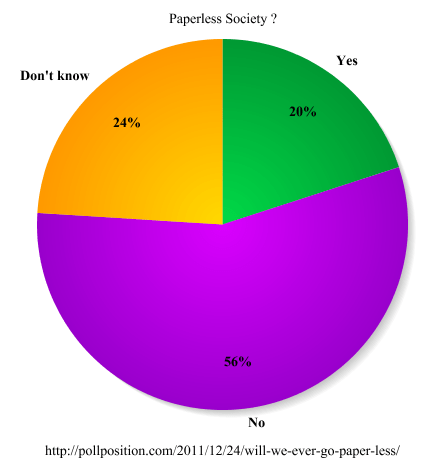
The trend will not change. A report from ITnewsLink reports that more than half of Americans think the U.S. will never go paperless. Pollster Poll Position conducted a national survey to see if Americans think the U.S. could ever be a paperless society.

Poll Position researchPoll Position’s research found that 56% of Americans said they don’t think the U.S. would ever be a paperless society. Only 20% said yes, one day we’ll all go paperless. 24% of Americans were undecided or had no opinion on the question.

Other Poll Position finding

  • 63% of the 18-29 age group said the U.S. would never be a paperless society and 23% said we could be a paperless society.
  • 56% of men and women said we could never be a paperless society.

You can still vote in their online companion poll.

rb-

I think that in an era of computers, Amazon (AMZN) Kindle Fire and Apple (AAPL) iPad tablet computers, iPhones and Google (GOOG) Android smartphones that paper consumption would decrease. Apparently it takes more than buzzwords like “paperless” and “green” to make a difference.

Related articles
  • The Paperless Office? (Going Green) (whattheythink.com)


Ralph Bach has been in IT long enough to know better and has blogged from his Bach Seat about IT, careers and anything else that catches his attention since 2005. You can follow him at LinkedInFacebook and Twitter. Email the Bach Seat here.

Social Media Biggest Risk in 2012

Social Media Biggest Risk in 2012The Security Labs over at Websense (WBSN) a provider of Web, data, and email content security have used the Websense ThreatSeeker Network (PDF) which provides real-time reputation analysis, behavioral analysis, and real data identification to announce (PDF) their picks for the top IT security threats for 2012. Social media is the #1 risk in 2012,.

1. Websense says that stealing, buying, trading credit card, and social security numbers is old news. They say that your social media identity may prove more valuable to cybercriminals than your credit cards.

LinkedIn connections for saleToday, your social identity may have greater value to the bad guys because Facebook (FB) has more than 800 million active users. More than half of FB users log on daily and they have an average of 130 friends. Trust is the basis of social networking, so if a bad guy compromises social media logins, the security firm says there is a good chance they can manipulate your friends. (Stacy Cowley at CNN Money has an excellent article on how this can work with LinkedIn (LNKD). Which leads to their second prediction.

2. According to Websense most 2012 advanced attacks’ primary attack vector will blend social media “friends,” mobile devices, and the cloud. In the past, advanced persistent threats (APTs) blended email and web attacks together. In 2012, the researchers believe advanced attacks could use emerging technologies like: social media, cloud platforms, and mobile. They warn that blended attacks will be the primary vector in most persistent and advanced attacks of 2012.

iPad malware3. The San Diego CA-based firm says to expect increases in exposed vulnerabilities for mobile devices in 2012. They predict more than 1,000 different variants of exploits, malicious applications, and botnets will attack smartphones or tablets. Websense security investigators predict that a new variant of malware for mobile devices will appear every day.

The Internet security firm stresses that application creators need to protectively sandbox their apps. Without sandbox technology malware will be able to get access to banking and social credentials as well as other data on the mobile device. This includes work documents and any cloud applications on that handy device. The firm believes that social engineering designed to specifically lure mobile users to infected apps and websites will increase. Websense predicts the number of mobile device users that will fall victim to social engineering scams will explode when attackers start to use mobile location-based services to design hyper-specific geolocation social engineering attempts.

SSL/TLS blindspot4. SSL/TLS will put net traffic into a corporate IT blind spot. Two items are increasing traffic over SSL/TLS secure tunnels for privacy and protection. First, the disruptive growth of mobile and tablet devices is moving packaged software to the cloud and distributing data to new locations.

Second, many of the largest, most commonly used websites, like Google (GOOG) Search, Facebook, and Twitter have switched their sites to default to HTTPS sessions. This may seem like a positive since it encrypts the communications between the computer and destination. But as more traffic moves through encrypted tunnels, Websense correctly says that many traditional enterprise security defenses (like firewalls, IDS/IDP, network AV, and passive monitoring) will be left looking for a threat needle in a haystack, since they cannot inspect the encoded traffic. These blind spots offer a big doorway for cybercriminals to walk through. (We have started to battle this as we move from a POC system from McAfee another vendor to a modem content filter to be nameless but was just bought and we haven’t solved it yet, the NoSSLSearch for GOOG still needs some work)

Network security5. For years, security defenses have focused on keeping cybercrime and malware out (Also called M&M security, hard on the outside, soft and chewy on the inside). The Websense Security Lab team says that there’s been much less attention on watching outbound traffic for data theft and evasive command and control communications. The researchers say hacking and malware are related to most data theft; they estimate that more than 50 percent of data loss incidents happen over the web. This is aggravated by delayed DLP deployments as vendors use traditional overly excessive processes like data discovery (designed to over-sell professional services?).

In 2012, organizations will have to stop data theft at corporate gateways that detect custom encryption, geolocations for web destinations, and command and control communications.  The security firm predicts organizations on the leading edge will add outbound inspection and will focus on adapting prevention technologies to be more about containment, severing communications, and data loss mitigation after an initial infection.

Black-Hat-SEO_full6. The London Olympics, U.S. presidential elections and Mayan calendar apocalyptic predictions will lead to broad attacks by criminals. SEO poisoning has become an everyday occurrence. The Websense Security Labs still sees highly popular search terms deliver a quarter of the first page of results as poisoned.

The researchers expect that as the search engines have become savvier on removing poisoned results, criminals will port the same techniques to new platforms in 2012. They will continue to take advantage of today’s 24-hour, up-to-the-minute news cycle, only now they will infect users where they are less suspicious: Twitter feeds, Facebook posts/emails, LinkedIn updates, YouTube video comments, and forum conversations. Websense recommends extreme caution with searches, wall posts, forum discussions, and tweets dealing with the topics listed above, as well as any celebrity death or other surprising news from the U.S. presidential campaign.

Scareware7. Scareware tactics and the use of rogue anti-virus, will stage a comeback. With easy to acquire malicious tool kits, designed to cause massive exploitation and compromise of websites, rogue application crimeware will reemerge Websense says. Except, instead of seeing “You have been infected” pages, they expect three areas will emerge as growing scareware subcategories in 2012: a growth in fake registry clean-up, fake speed improvement software, and fake back-up software mimicking popular personal cloud backup systems. Also, expect that the use of polymorphic code and IP lookup will continue to be built into each of these tactics to bypass blacklisting and hashing detection by security vendors. (Rival IT Security firm GFI Software proves Websense’s point by reporting a “new wave of fake antivirus applications (or rogue AV)” since the start of the year and are “a popular tactic among cybercriminals.”)

Related articles


Ralph Bach has been in IT long enough to know better and has blogged from his Bach Seat about IT, careers, and anything else that catches his attention since 2005. You can follow him on LinkedInFacebook, and Twitter. Email the Bach Seat here.
How Does Your Equipment Stack Up?

How Does Your Equipment Stack Up?Engadget points us to phone-size.com that lets you compare the relative proportions of different smartphones. At the top of the webpage, you’ll also find a toolbar to enter the size and aspect ratio of your display. Once you jump through this minor hoop, according to Engadget, the utility produces accurate, life-size depictions of smartphones like Apple’s (AAPL) iPhonesGoogle’s (GOOG) Androids, and Research In Motion’s (RIMM) Blackberrys.

rb-

Really wanted to use the title.

Related articles


Ralph Bach has been in IT long enough to know better and has blogged from his Bach Seat about IT, careers, and anything else that catches his attention since 2005. You can follow him on LinkedInFacebook, and Twitter. Email the Bach Seat here.

Flip the Switch on IPv6

Flip the Switch on IPv6World IPv6 day (Which I reported on here) took place in June 2011. Google (GOOG), Facebook, Yahoo (YHOO), and Akamai (AKAM) were among the participants in last year’s new networking dress rehearsal. apparently, everything went well last June.

Internet SocietyNathan Ingraham at The Verge recently noted that IPv6 is now ready for prime-time. The Internet Society announced that the IPv6 switch will be permanently flipped on June 6th, 2012.

The article says a number of major ISPs, networking hardware manufacturers, and web companies pledged support from day one. For starters, four of the biggest web properties will all enable IPv6 permanently:

Cisco logoFrom a hardware perspective, Cisco (CSCO) and D-Link (2332) both committed to enabling IPv6 across their range of home products by June.

GigaOM reports that Akamai (AKAM) and Limelight (LLNW) will also recruit other websites to join the initiative, by implementing IPv6 throughout their content delivery networks.

Several leading ISP’s will enable IPv6 to enough of their customer base that at least one percent of their residential subscribers who visit IPv6 enabled websites;

rb-

The internet is quickly running out of IP addresses, the last addresses in Internet Protocol version 4 were officially distributed early in 2011 Which I wrote about here.

Related articles


Ralph Bach has been in IT long enough to know better and has blogged from his Bach Seat about IT, careers, and anything else that catches his attention since 2005. You can follow him on LinkedInFacebook, and Twitter. Email the Bach Seat here.