Australia’s national science agency, the Commonwealth Scientific and Industrial Research Organization (CSIRO) has won its Wi-Fi patent troll case. They confirmed (4-22-09) that the patent cases heard in the Eastern District Court of Texas as concluded “successfully.” CSIRO sued most of the tech world over its claim of inventing the technology behind Wi-Fi Wireless Local Area Networks (WLANs).
 CSIRO claims to have patented core elements of the technology used in 802.11a and 802.11g wireless devices. “CSIRO has negotiated settlement with each of the 14 companies involved in four concurrent litigation cases,” the agency said in a statement. “The commercial terms of the settlements with these companies will remain confidential.”
Wi-Fi patent claim
The CSIRO first applied for the US patent in 1993. It was awarded US patent number 5,487,069, entitled “Wireless LAN” on 23 January 1996. The patent describes a “peer-to-peer wireless LAN” that can operate in the kind of multi-path environment created by radio echoes in typical office buildings. It includes three ways to get high-speed transmission despite the hostile conditions in an office environment. First, they describe transmitting over a relatively large number of parallel sub-channels within the available bandwidth so that each channel has a low bit rate. Second, the patent describes transmitting data in small packets with forward error correction (FEC) and using interleaving. These concepts are all featured in descriptions of the 802.11 physical layer CISRO claims to have patented core elements of the technology used in 802.11a, 802.11g, and 802.11n wireless devices.
 CSIRO has previously said that its patent allowed speed increases up to a factor of five over previous WLANs. They claimed to have, “offered licenses on reasonable and non-discriminatory terms to major suppliers as soon as they started selling devices which used the CSIRO technology.”
However, troubles began following the Cisco (CSCO) acquisition of Radiata from Macquarie University. The university had carried out for the purpose of commercializing CSIRO’s technology. Now CSIRO claims the work forms a key part of commonly used Wi-Fi products
The CSIRO filed Wi-Fi patent infringement suits against 3Com, Accton (2345), ASUS (2357), Belkin, D-Link (DLINK), Fujitsu (6702), Marvell (MRVL), (manufacturers of Apple’s (AAPL) iPod), Nintendo (7978), SMC and Toshiba (TOSBF). Several large technology vendors bit back – with Apple, Dell (DELL), HP (HPQ), Intel (INTC), Microsoft (MSFT), and Netgear (NTGR) bringing cases against CSIRO in trying to have the patent invalidated.
In June 2007, the CSIRO won a case in the U.S. Federal Court against Japanese manufacturer Buffalo Technologies. This win is the basis the firm has used to demand royalties from a broader set of manufacturers that market Wi-Fi equipment.
As the case has played out in the last few weeks in and out of the Texas court, CSIRO struck individual deals with its adversary’s including; Dell, Fujitsu, HP, Intel, and Microsoft
HP was the first to settle on 04-02-09. CSIRO spokesperson Huw Morgan said, “CSIRO can confirm that a settlement has been reached with Hewlett-Packard Company in relation to the wireless patent case.” Mr. Morgan continued in the Sydney Morning Herald, “There will be no further comment at this time due to confidentiality and ongoing litigation.”
 Fujitsu Computer Systems Corp. was dismissed by the Court with prejudice in the first court-approved settlement to emerge in the case on April 8. The terms of the settlement remain confidential.
PC manufacturer Asus and Microsoft separately settled their lawsuits with the CSIRO on 04-14-09 terms of the settlement were not disclosed. CSIRO had accused Microsoft of wrongfully using its patent. Microsoft was seeking a ruling of non-infringement for the wireless technology included in the Xbox video-game system.
 Intel and Dell also settled on 04-19-09 for undisclosed and confidential terms.
Accton Technology Corp., SMC Networks, Belkin Corp. and Belkin International, Inc., D-Link Systems, Inc., Netgear, Inc., Nintendo of America, Inc., Toshiba America Information Systems, Inc., and 3Com Corp., announced on 4-20-09 that they had reached a settlement with CSIRO.
Cisco and its Linksys division aren’t on CSIRO’s list. Cisco agreed to patent terms when it acquired an Australian network authentication firm a few years ago. Apple dropped out in December 2006.
Dr. Alex Zelinsky, director of the CSIRO ICT Center confirmed that all CSIRO opponents had chosen to settle the wireless case. CSIRO deputy chief of operations Mike Whelan said that the terms of the settlement would remain strictly confidential. Dr. Zelinsky speculated to ITNews, however, that the payoff could be worth upwards from $100 million up to a billion dollars and keep royalty payment flowing into the agency for up to a decade.
- November 1993: CSIRO lodges a US patent for the invention of a wireless LAN.
- January 1996: US patent 5,487,069 is issued to CSIRO.
- 1997: CSIRO and Macquarie University form Radiata, a company established for the purposes of commercializing the patent.
- 2001: Cisco Systems acquires Radiata for $295 million.
- 2003: CSIRO engages in patent licensing discussions with several manufacturers, none of which agree to pay licensing fees.
- February 2005: CSIRO lodges a suit against Buffalo Technology for alleged patent violation in the Eastern District of Texas Court as a test case for its patent.
- May 2005: Two groups of industry heavyweights — including Dell and Intel, and Microsoft, HP, and Netgear, lodge lawsuits against CSIRO seeking to overturn its patent.
- November 2006: CSIRO has its patent upheld by the Eastern District of Texas Court in its case against Buffalo Technology.
- September 2006: CSIRO counter-sues the industry parties attempting to overturn its patent, claiming these companies infringe on its patents.
- September 2007: CSIRO refuses to offer any amnesty to IEEE members that infringe on its patent.
- April 02, 2009, HP settles suit.
- April 13, 2009, Microsoft settles suit
- All other firms settle the suit on April 20, 2009.
rb-
If your installation includes Aruba, Meru, or Trapeze, you can hope that CISRO goes back to developing Wearable Instrument Shirts or Airhockey Over a Distance, and not squeezing more revenue for the taxpayers of Australia out of this initial victory by going after all the other Wi-Fi vendors. If upheld, CSIRO will collect what it has often described as a small royalty on all devices containing Wi-Fi.
The cases are:
- Intel Corp. v. Commonwealth Scientific and Industrial Research Organization, 06cv551
- Microsoft Corp. v. Commonwealth Scientific and Industrial Research Organization, 06cv549, U.S. District Court, Eastern District of Texas (Tyler)
Ralph Bach has been in IT long enough to know better and has blogged from his Bach Seat about IT, careers, and anything else that catches his attention since 2005. You can follow him on LinkedIn, Facebook, and Twitter. Email the Bach Seat here.


 The latest malware attack vector is the network interface card (NICs). According to a post at Gizmo’s Freeware, two separate presentations at the CanSecWest international security conference demonstrated exploits utilizing network cards. The article reports that both exploits focused on Broadcom (AVGO) NIC’s.
 The post reports that in at least one of the demo’s the researcher used the Broadcom remote factory diagnostic mechanism to install custom firmware on the network card. The researcher used the compromised firmware to create a tunnel into the PC in such a way that packets sent via the tunnel were not visible to the system firewall. Using the network card’s access to memory, the attacker could then run whatever code he wanted.
 P has made softpaq SP47557 available to resolve the vulnerability. In the bulletin, HP says the following models contain the Broadcom Integrated NIC firmware
 The global body count in the tech sector has risen above 500,000 in July 2009. Since the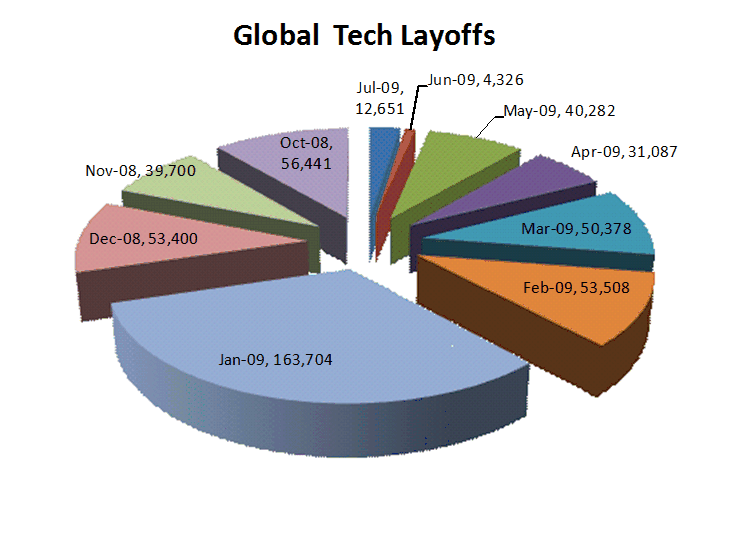
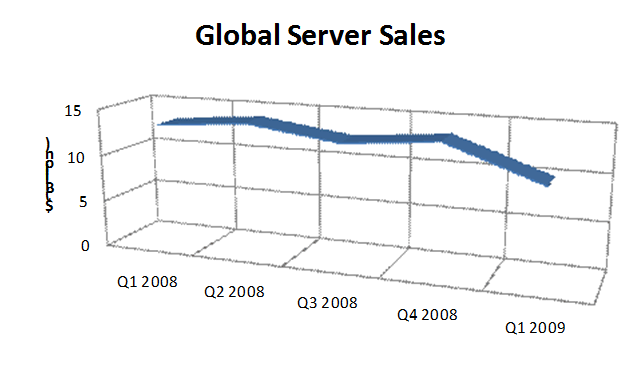
 Like most of us (except the bankers) global sales of servers have taken a beating since the first quarter of 2008. Server sales have declined by over $3 billion due to the