The U.S. Environmental Protection Agency released an Energy Star specification for computer servers on May 15, 2009. This new specification covers standalone servers with one to four processor sockets is in part a reaction to estimates that by 2011, IT equipment is expected to account for 3 percent of all U.S. electricity consumption, according to the EPA.
 Andrew Fanara of the Energy Star product development team helped spearhead the process of getting a spec for servers told DataCenter News. “EPA believes this new server spec is an important first step to help attract attention to the need and opportunity to cut cost and save energy in federal data center facilities, especially during a time of tight budgets,” Fanara told GCN.
The new specification includes:
- Power supply efficiency requirements which should increase efficiency and reduce waste heat
- Power consumption limits for when the server is idle
- Single-socket server are limited to 60 watts
- 2-3 socket servers are limited to 151-221 watts
- Allowances for additional installed components
- Power and performance data sheet detailing power consumption in a common format
- Ability to report energy-related statistics to data center management software.
Vendors Respond to Energy Star for Servers
 Major server manufacturers are already submitting their products for Energy Star approval. HP says that two of its most popular servers, the DL360 and DL380 G6 are now Energy Star compliant with more servers added to the list soon.
IBM‘s next-generation Power6 processor has power management abilities that let it drop down to a 100-watt level.
 Jay Dietrich, program manager at IBM’s corporate environmental affairs group told GCN,“Overall, we think that there has been good progress on the server requirements, and we think EPA has done some good work in getting that specification focused on the issues.”
N ot to be left out, Dell launched an energy-efficient server line in December. Dell touts it’s PowerEdge Energy Smart 1950 III and 2950 III servers as the Dell green alternatives.
Sun Microsystems has touted the energy efficiency of its UltraSparc T1 “Niagara”-based servers for a while . The Niagara CPU typically uses 72 watts of power at 1.4 GHz.
Criticism of Energy Star for Servers
 The new Energy Star criteria has its critics. The biggest complaint is that a qualifying server need only show energy efficiency when it’s in idle, powered on but doing no work. This is like comparing the mile per gallon of a Hummer and a Prius sitting at a stop light. Both use a similar amount of fuel idling, not going anywhere. Many argue that the amount of energy spent idling is less important than how many miles per gallon the vehicle gets while driving, doing its work.
However, firms are becoming increasingly aware of this issue and are addressing it. Organizations are deploying virtualization to cut underutilized servers to get as much performance per watt as possible from their hardware. In most IT organizations there are underutilized servers which spend a great deal of time idling, so idle server power consumption is relevant but not the whole story. Servers are not like desktop or laptop computers because they are not meant to be idle. Instead, they are designed to be highly utilized and available. “A heavily utilized server is much more energy effective than a small server running at very low utilization rates,” Albert Esser, vice president of data center infrastructure at Dell told GCN.
Subodh Bapat, a distinguished engineer at Sun explained to Data Center News another drawback to the program: It doesn’t take into account how many cores per processor a machine has. “The fact is, when you go from a server that has four processors with two cores each to two processors with four cores each, you save energy. That’s not recognized by the spec,” he said. “If you’re shipping a server with one processor, it doesn’t matter if you have one core or two cores or four or eight. You still get the same idle power allowance. There’s no benefit for the fact that you can do, say, eight times work with a fewer number of watts.”
“This is a great first step, but it’s not a complete spec,” says Bapat. “It’s a good start toward finding out which servers are better than others on an energy basis.” Bapat wasn’t entirely critical about the Energy Star program for servers. For example, a compliant server must be capable of measuring real-time environmental data . “Transparency is always a good thing. Energy Star requires the ability to report power consumption data pretty much across the range of utilization and at all times that the server is on. If you want to know how much [power is being consumed], you should be able to ask it and it should tell you. That’s a very useful feature.”
EPA Responds
 The Tier 2 Energy Star specification will cover servers with more than four processor sockets, blade servers and fault-tolerant machines is expected in October 2010. The Tier 2 spec will also define a metric that compares server performance with energy consumption. EPA’s Fanara speculates that finding the magic numbers, could take a while. The EPA is developing an Energy Star spec for data center facilities and is collecting data from volunteering data centers now. Mr. Fanara said his group also hope to have a framework document for an Energy Star for data storage equipment out in June 2009.
EPA introduced Energy Star in 1992 as a voluntary program to reduce greenhouse gas emissions through energy efficiency. The Energy Star label can be found on more than 50 kinds of products, new homes and commercial and industrial buildings. Energy Star is the EPA labeling program designed to help consumers pick out energy-efficient products. If a manufacturer qualifies its product, it can place an Energy Star label on it, and the product information can also be displayed on the manufacturer’s and the Energy Star Website.
rb-
I agree with Sun’s Bapat that the current version of the Energy Star requirements for servers is a good first step. Just like any 1.0 version release, there is still a lot of work to be done.
Ralph Bach has been in IT long enough to know better and has blogged from his Bach Seat about IT, careers and anything else that catches his attention since 2005. You can follow him at LinkedIn, Facebook and Twitter. Email the Bach Seat here.


 NetworkWord is reporting that the U.S. government has reportedly launched a comprehensive product testing program for IPv6. The new program, USGv6 Test Program, will be run by the National Institute of Standards and Technology (NIST) will require all network hardware and software vendors to pass IPv6 compliance and interoperability tests before they can sell their products to the U.S. federal government market.
 The
The  The U.S. government alleges that the people arrested in


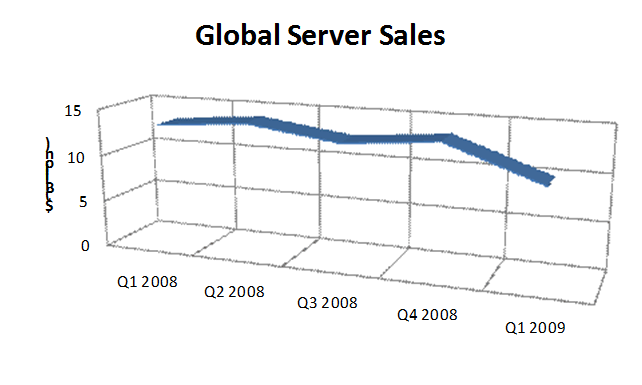
 Like most of us (except the bankers) global sales of servers have taken a beating since the first quarter of 2008. Server sales have declined by over $3 billion due to the